METU welcomes this Institutional Evaluation process as a valuable
opportunity to blend the experience of a knowledgeable group of international
`peers` with the University’s assessment of its past and present at various
levels. The feedback to be received from this review will contribute to METU`s
continuous efforts to
·
Institutionalize
its strategic management practices,
·
Implant a
quality assurance system and
·
Reinforce its
quality culture.
In the first 25 years following its establishment in 1956, METU enjoyed
the special status specified by law to rapidly grow and evolve into a highly
prestigious international university. With the passing of the Higher Education
Law in 1982, METU was deprived of its special status and joined the ranks of
the other state universities. Since then, METU has experienced a series of
massive changes that have created a threatening environment, namely increased
rigidity in financial and human resources management, uncontrolled increase in
student enrollment, and erosion of staff salaries.
Pushed by developments in the European higher education area and the
advancements in technology, and pulled by shrinking resources, METU’s upper
administration has striven to be proactive about the future of the University
in order to continue to play a critical role in the rapidly changing world.
It is our expectation that the Self Evaluation exercise will
contribute a great deal to control the progress of METU, to avoid unpredictable
and chaotic contingencies, to shape up and to exploit its environment. It is
also expected that this exercise will add to the knowledge base that METU has
obtained from other assessment and accreditation procedures in the past. In
particular, this Institutional Evaluation practice has already helped to
trigger the formation of “Self Evaluation Committees” in all the departments,
faculties, and graduate schools of the University to continuously assess and
evaluate their individual units and to prepare their own strategic and
operational plans.
This Self Evaluation Report was coordinated and guided by the University
Self Evaluation Committee (USEC), whose members include a Vice Rector, two
Assistants to the Rector and faculty members from various disciplines. The list
of the USEC members is provided in Appendix
1. The report was first drafted by the USEC, then reviewed by the
university upper administration, and finally made available to all faculty
members for their individual contributions.
The Self Evaluation Report incorporates findings from two types of
sources:
1.
The routine
data collection and assessment mechanisms, and periodic reports produced by the
University at different organizational levels;
2.
A number of
special-purpose studies, non-routine reports, and review/accreditation
processes completed in recent years, notably:
- “METU
Strategy Document 1995-2000” and “METU Strategy Document 2000-2005” (Appendix
3);
- Two
reports submitted to the Prime Minister to summarize the financial, administrative,
and human resource problems encountered by the state universities together
with suggestions for changes in the legal framework, prepared by METU and
other state universities (January and February 2001);
- A
participative study entitled “The R&D
Road Map of METU,” commissioned in 2000 and completed in December 2001;
- A “SWOT Analysis” performed as a
part of this Self Evaluation Process, with the participation of current
and former upper administrators, as well as academics and students
(September-November 2001) (Appendix 18);
- Experience with previous assessment and accreditation processes
conducted in various faculties by national and international bodies.
The present
university mission statement reads:
“The Middle East Technical University is devoted to the pursuit and
application of knowledge for the social, cultural, economic, scientific and
technological development of our society and humankind through achievements in
teaching, research and community services that are of the highest international
standards”.
The University practices to fulfill the expectations laid out in the
mission statement are supported by a set of guiding principles given in Appendix
2. The major functions of the University underlined in the mission
statement can be assessed in two areas:
i. Education and Research: METU is
renowned for its traditionally impressive undergraduate education in a large
number of disciplines, encompassing also a respectable graduate education. METU
graduates have served with competency, showing leadership to promote new
professional fields at institutions both at home and abroad and to establish
critical links between Turkey and the world. The METU image in society is a
well-deserved university asset, which also necessitates continuous effort to
maintain at a level of performance to satisfy demands.
Modeled after US campus universities and having English as the language
of instruction, METU has enjoyed important advantages over the other Turkish
universities and served as a model in many ways.
Despite the fact that METU has a leading position in academic research
in Turkey accommodating valuable researchers in its institutional body, limited
access to resources slows down the rate of pioneering research carried out. The
research performance is based primarily on the capacity of individuals or small
groups rather than on large-scale collaboration. There are modest incentives
provided by the University and public agencies to bolster the academic research
capacity. Graduate education, laboratories and technical support systems, and
research links to international research centers require considerable
improvement and restructuring. The METU researcher profile reflects a respectable
level of awareness of research objectives and the output, but this profile is
not reflected as much as it should, towards collaboration and large projects.
Most faculty regard research primarily as an individual effort, while links to
stakeholders, and to society at large, are viewed as secondary. On the other
hand, it is crucial to note that the national demand for academic or industrial
research is still very low.
ii. Services and Linkages: METU faculty are
very active as advisory agents to governments and private companies. The
consultancy services in general are mediated through personal contacts and
project applications made to the departments. The METU staff have become a
popular pool of expertise for innovations carried out in the public and private
sectors. However, the commercialization of university knowledge has yet to
become an integral part of academic life. The faculty still need to develop the
necessary organization and management skills to link up with the external
production and research activities, to join clusters of industrial/service
institutions, and to take part in networking activities at the national/global
levels.
As a part of its efforts to establish sustainable links with the outside
world, METU has started to review the contents of its academic programs and
institutional performance for continuous quality improvement. Upon the request
of all engineering programs, ABET (Accreditation Board for Engineering and
Technology), as a formal external evaluator, having judged these programs,
reported that they are “substantially equivalent to similarly named accredited
programs in the USA”. This is the only kind of positive accreditation statement
provided by ABET for programs outside the USA.
To support the realization of its mission, METU has attributed great
significance to the following projects:
1. Consolidation of METU as a Research
University of International Recognition: The University aims to be a dynamic institution seeking excellence in
an international context. To this end, it strives to attain the legal status,
to actively participate in international research and education networks, and
to attract highly qualified teaching and research staff and high quality
students. For this purpose, METU has established the European Union and
Socrates Offices to follow the higher education activities in Europe and to
inform the faculty about various possibilities for research and collaboration
with the EU Member States.
2. Academic Human Resources Development: The University gives priority to research
by encouraging graduate and especially PhD programs, based on national and
international projects, and offering solutions to the problems of our society
and humankind, thus helping to meet the need for academic staff in Turkish
universities. For this purpose, METU has recently established collaborative
programs with four newly-established or developing universities in Turkey,
enabling the prospective faculty of these universities to conduct their PhD
studies at METU. The financial support for the program is provided from a
university project already approved by the State Planning Organization.
3. METU-Technopolis and Incubation Center
(TEKMER): The University
strives to give shape to a research structure integrated with regional and
external sectors and nurture the development of METU-Technopolis and the
Incubation Center. The University aims to contribute to innovations and
developments in technology by directing graduate and PhD theses as well as the
research efforts of faculty towards METU-Technopolis and the Incubation Center,
thus establishing a healthy and productive structural relation between the
University and these two centers. Both METU-Technopolis and the Incubation
Center are the first of their kind in Turkey (Appendix 13).
4. Distance Education: The University aims to pioneer the
development of distance-learning tools and methods based on the Internet. It is
the intention of the University to assume a leading role in national and
international activities of this kind and to develop joint distance education
programs through cooperation with a number of certificate and graduate programs
on the Internet (Appendix 9).
5. METU-Northern Cyprus Campus: The University desires to develop the METU-
Northern Cyprus Campus on a sound structure, and to set up academic programs after
discussing various administrative and academic matters in detail with the
participation of the entire faculty.
However, there exist severe constraints limiting METU’s efforts to
realize the goals covered in its mission statement. It should be noted that an
immediate consequence of inadequate financial resources and inflexible higher
education law cause the loss of qualified academic personnel. The search for better paying jobs or moonlighting
options by the academics is posing a serious threat to the quality of the
University.
METU is also facing the danger of becoming an “aging university” in many
respects. Besides the lack of interest of young graduates in an academic career
and the ever-rising average age of academics, the University has entered its
maturity stage. Multidisciplinary programs are emerging
(Appendix 11) amidst the single-discipline traditions; partnership
and networking cultures are developing against a background of low
connectivity. The inequality in salaries between research assistants and those
with jobs outside the university is discouraging students from applying for
demanding graduate programs.
The Higher Education Council (HEC) plays a crucial role in the Turkish
higher education system. It is responsible for the planning, coordination and
supervision of higher education within the provisions set forth in the Higher
Education Law (Appendix 14).
The Interuniversity Board, comprising the rectors of all universities
and one member elected by the senate of each university serves as an academic
advisory body to HEC. The Minister of National Education, on the other hand,
represents higher education in the Parliament and can chair the meetings of the
Council, as a non-voting member. Decisions of neither HEC nor the universities
are subject to ratification by the Ministry.
Universities, faculties and schools are established by law, while the
establishment of departments is approved by HEC. Likewise, the opening of a degree
program at any level is subject to ratification of HEC. Upon the recommendation
of the Interuniversity Board, HEC determines common course requirements for
such programs. Universities are completely free to decide on the rest of the
curricula, course contents, grading systems and degree requirements. Teaching
methods and grading are prerogatives of the individual instructors.
a-
Selection and Appointment of (full) Professors and Other Academic Staff
Both academic and administrative staff in
state universities have civil servant status. The number of academic and
administrative staff cadres allocated to each state university is determined by
the acts of the Parliament, while staff appointments at all levels are made
exclusively by the universities and are not subject to approval by any external
authority.
The Higher Education Law, given in Appendix
14,
sets forth the minimum requirements for academic promotions and the procedures
to be followed in making appointments. METU has specified additional criteria and requirements to be met for
the appointment and promotion of its academic personnel. These criteria and the
relevant procedures are explained in Appendix
15.
The student quota for bachelor programs is
determined annually by HEC, upon the recommendations of the universities. Admission of students to Turkish
universities is based upon a central examination, organized by the Student
Selection and Placement Center. High school graduates applying for admission to
higher education must take the Placement Examination for Turkish Universities.
Approximately 1.5 million students take this examination every year.
Foreign students are accepted to degree
programs in Turkish universities based on the basis of their scores on the Foreign
Student Examination, which is administered at the Turkish Consulates in several
countries and in the capital, Ankara, in June every year.
On the other hand, universities are free to
determine the number of students to be admitted to graduate programs. During
the selection process of these students, their performances in previous
undergraduate and graduate education and nationwide Graduate Education
Examination scores are taken into consideration.
METU, also provides a continuing education
service to society at large, through its Continuing Education Center. Catalogue
seminars and courses, as well as customized certificate programs depending on
the specific needs of participants are announced and conducted each year (Appendix
12).
State financing from “annexed budget” funds: METU, relies primarily on state funding,
with up to 65% of its revenues coming from the “annexed budget”. The annual
budgeting process begins in early summer with the submission of the university
budget proposals to the Ministry of Finance for the “current expenses” budget
and to the State Planning Organization for the “infrastructure” budget. After
various meetings for justification, the funding agencies prepare the national
budget proposal and submit it to the Grand National Assembly for ratification.
The total funds allocated to the University inevitably fall short of the
proposal. Equally importantly, the line-item distribution of the funds
allocated to the University is not necessarily in line with the priorities expressed
by the University. Moreover, its ability to re-allocate the “annexed budget”
funds is extremely limited. The strict implementation of the “line-item” system
throughout the year further exacerbates the rigidity of the budgeting process.
Transfer of the “current expense budget” funds among line items –in an effort
to make the budget better respond to the university objectives or unanticipated
needs emerging within the fiscal year– is largely curtailed by the system. It
is, however, possible to secure State Planning Organization approval for
re-allocation of funds between similar
items in the infrastructure budget.
While the funds budgeted along line items are released in quarterly
installments, the actual procurement needs of the University are not equally
spaced throughout the year. Moreover, the overly confining
“purchasing-tendering” by-laws and regulations create extensive bureaucracy
which unduly prolongs most procurement efforts, and at times denies choices
that would result in provision of goods and services at lower costs. Subject to
the Turkish Court of Accounts audits which strictly adhere to the letter of the
by-laws and regulations, the University currently has very little flexibility
or discretion in using state funds.
The Ministry of Finance recently started a major reform project to
initiate a “performance budgeting” system in the Turkish public sector. The six
state agencies (including the METU Library and Documentation Center) chosen as
pilots are in the process of developing strategic planning and performance
measurement systems as the basis for their 2003 budget proposals.
Student Tuition Fees:
Student tuition fees comprise the second largest source of funds for most
Turkish state universities. Tuition fees vary according to faculty,
undergraduate /graduate program and the number of semesters the student has
already spent at METU. Different tuition fees are charged to Turkish and
international students. In this context, the range of tuition fees per semester
is $50-$220 for Turkish students and $240-$975 for international students.
The University can allocate funds generated from the tuition fees to any
line-item as its needs dictate. However, due to the strict
“procurement-tendering” by-laws and procedures as well as stringent Turkish
Court of Accounts audits, extensive bureaucracy hampers efficient use of these
funds.
Revolving Fund Revenues: The University has a free hand
in the pricing of its non-degree teaching/training programs, contract research,
and consultancy services. However, in addition to the stringent
“procurement-tendering” by-laws and regulations that encumber the conduct of
duties, there are also specific rules that dictate how the University can use
these funds in financing its needs.
The pending amendment to the Higher Education Law is expected to provide
the state universities with greater discretion in setting tuition fees for
Turkish students and total freedom in the case of international students. It is
expected to increase flexibility in the management and the use of revolving
fund revenues generated by the state universities.
Support from the METU Development Foundation: The mission of the METU Development
Foundation includes generation of funds to complement the activities of the
University. The entrepreneurial activities carried out under the auspices of
the Foundation are explained in Section
2.2.1.f.
Rental Fees and Other Revenues: The University generates funds by renting/leasing land, buildings and
facilities to companies operating on the campus. Here, too, certain Ministry of
Finance regulations specify the tender/auction processes to be followed, and in
some cases even determine the rental rates. More importantly, due to changes,
from one year to the next, in the rules accompanying the Budget Law, there has
been no consistency as to the beneficiary of these revenues (i.e., the
University or the Ministry). Lately, the view that universities should receive
these funds to complement their tuition fee revenues has been gaining wider
support. The pending amendment is expected to finalize the issue in favor of
the universities.
University Research Fund: METU, as do all state universities, has a research grant fund to
support projects submitted by individual faculty members and research units.
The contributions to the University Research Fund come from the annexed budget,
the revolving fund, and the tuition fees of certain graduate programs. The
total annual budget, ranging from $1 to $1.5 million, is distributed at the all
university levels, using performance-based allocation criteria and competitive
awarding to support faculty members as well as graduate thesis/dissertation
work.
Undergraduate programs are designed for four years of study beyond a one
year intensive English language preparatory program, if needed, conducted by
the Department of Basic English.
To receive a bachelor’s degree in any of the programs at METU, each
student must successfully complete a course of study as specified in the
official curriculum of the program published in the University catalogue.
Undergraduate students are expected to have a grade point average (GPA)
of at least 2.00/4.00 and at least a DD grade for each course every semester in
order to complete their programs successfully on time. A cumulative grade point
average (CGPA) less than 1.80 results in academic probation, a situation in
which the student must rectify within two semesters.
Graduate
Schools and Research and Development Centers are the major organizational
entities responsible for conducting and coordinating research activities at
METU. While the former are founded by law, the latter are established with the
approval of university boards and HEC, depending on their size and type.
Given the fact that
various bodies of the University are under pressure to attend to a variety of
issues, a separate unit is needed that primarily focuses on academic concerns
at the graduate level. The responsibility for planning, implementing,
coordinating, and evaluating graduate programs, as well as for setting out new
policies in search of excellence in graduate education rests with the four
Graduate Schools, namely the Graduate Schools of
·
Natural and Applied Sciences,
·
Social Sciences,
·
Marine Sciences and
·
Informatics.
Apart from these, there are a total of 37 research and development
centers in the University. Among them, 11 centers directly report to the
Rector’s Office and undertake multidisciplinary research activities (Appendix
16).
Only a few of the research centers are well established and carry out
substantial research projects, the remaining are relatively less active.
Research centers are expected to be self-sustaining and not to use the already
limited resources of the University. However, since they are established
without a resource plan concerning physical space, infrastructure, or cadre for
administrative and technical personnel, their research performance is
insufficient and in their present situation they constitute a financial burden
to the University.
The research centers are not price-competitive to receive industrial
projects from outside the University, owing to the additional cost of
contributions to revolving funds. The recent changes in the allocation of the
revolving funds and the new Technopark Law, which eliminates the state taxes
and university shares, further reduce the significance of the research centers
in the University.
As directing or taking part in the activities of a research center does
not reduce the regular academic or administrative workload of the directors or
researchers, these centers survive through individual efforts.
Entrepreneurial
activities at METU are carried out through two channels. The first channel is
the Incubator, which provides an opportunity for young entrepreneurs to start
up their businesses by putting their technological projects into practice. The
Incubator was established in 1992 as a
result of cooperation between METU and Turkish SMIDO (Small and Medium Industry
Development Organization). The infrastructure in terms of the University
library and laboratories combined with the experience of the University
regarding local and international research projects have produced a fertile
environment for the companies in the METU Incubator. Hitherto, 22 companies
have successfully ‘graduated’ and 28 companies are still continuing with their
research and product development activities there. The Incubator has a success
rate of 79%.
The second channel for entrepreneurial
activities is METU-Technopolis (Appendix 13). The successful experience
with the Incubator has led the University into establishing a technopark in
which R&D activities of relatively larger and medium size companies could
be accommodated. After 6 years of intensive effort, in 1998, METU-Technopolis
was officially established. Today 39 companies, 7 of which graduated from the
Incubator, are conducting their R&D activities within METU-Technopolis. The
legislation concerning technoparks (Technology Development Regions Act) was
approved by the Parliament and became effective as of July 7, 2001. This new
legislation provides some financial incentives for the R&D activities of
the companies operating in METU-Technopolis. Both the Incubator and
METU-Technopolis provide opportunities for the faculty to participate in the
research activities of industry and/or to establish their own companies in
METU-Technopolis in order to commercialize the results of their research
activities. The outcome of this is yet to be seen.
Additionally, the revenues generated by the METU Development Foundation
are used to support various services both within the University and outside.
The Foundation supplies scholarships and accommodation to students, as well as
providing services outside the scope of the annexed budget. The METU
Development Foundation also gives awards to the faculty for their publications
and outstanding performance.
The high unsustainable levels of public debt
has plagued the Turkish economy in recent years, with nominal interest payments
on domestic and international debt absorbing as much as 50% of the annual
national budget. Due to insufficient state funds and the low priority assigned
to higher education, the “per student” public funding provided to state
universities has fluctuated between $1,000-$2,000 in the last decade (excluding
distance learning programs).
In addition to insufficient funding by the
state, frequent economic/financial crises in Turkey during recent years have placed
major burdens on state universities in the form of:
·
Rapid
devaluation of the Turkish Lira, eroding the annual budget, especially in
connection with purchase of books and equipment from abroad
·
Ever-increasing
need for financial aid for students
·
Reduction of
real wages of staff to untenable levels
The state universities face these conditions
while increases in the cost of providing higher education are endemic and
private universities continue to emerge rapidly on the Turkish scene.
Insufficient
state funds available to higher education in Turkey have to be distributed to
an ever-increasing number of state and private universities. With the newly
established state universities -- still in their peak construction-investment
phase -- receiving the highest share of the government funds, the
well-established universities, such as METU, face the difficult task of
persuading the funding agencies about their pressing financial needs. The
latter are forced to generate funds from revolving fund activities, real estate
rentals, donations, and university foundations. While the state implicitly
endorses revenue generation by state universities, the current legal framework
is not conducive to “university entrepreneurship”.
METU, with its outstanding
architecture and efficient campus planning, has a unique setting. Since its
establishment in the capital city, it has become the source of inspiration for
a privileged life style mediating between continuous cultural and natural enhancement.
The initial campus plan – the product of an international competition held in
1961– was designed to meet the needs of 10,000 students and for a daily
population of 30,000 within an area of 4,500 hectares, including a forest and
Lake Eymir.
The separation of the pedestrian circulation from the vehicle traffic,
which routes a loop around the academic zone and the administrative center, was
the fundamental principle of the project applied.
Over the years, the University has been forested entirely and has
reached an area of more than 450,000 square meters of floor space.
The characteristics of the campus changed its significance with the
rapid growth of the city; now, new residential, commercial and educational
areas surround it. METU, today, is a town created from scratch and bears most
of the attributes and problems of urban life. It has expanded to include a
technopark, a culture and convention center, a
museum and an antique site, a shopping area, a health center, an olympic
indoor, and a semi-olympic outdoor swimming pool, sports centers, a stadium,
tennis courts, and related infrastructure. Thus, the control of the campus
entrances, the overall traffic, and the car parking system require
re-consideration. While expanding its built environment within the scope of the
existing master plan, the challenge will be maintaining the balance between the
flora/fauna created and the built environment constructed.
2.2.4
Opportunities and Threats with respect to METU’s Environment
The major threat to the University’s social and human capital appears to
be the lack of financial resources and low salaries. In conjunction with the
rigid higher education system, they are adversely affecting the revitalization
efforts by the University at a time of rapid global changes.
Amid such difficulties, METU has to face the competition brought about
by the new private universities through better funding and upgrading of some of
its programs. The competitive pressures of international educational and
research institutions on the domestic market are also significant. Another
important threat originates from the weakness of the links with industry,
government, other universities and international/global organizations. The low
domestic R&D demand and ever-increasing brain drain are aggravating this
problem. However, if successfully tapped, the international reputation of METU
graduates and the prominent Turkish researchers living abroad also provide
important opportunities. Equally important is the recently emerging demand for
domestic R&D and a skilled work force in order to build up international
competitiveness in a knowledge-driven economy and in particular in order to
facilitate joining the EU. The ongoing national reforms and harmonization
efforts carried out as parts of EU candidacy are creating favorable conditions
for achieving METU goals.
2.3.1
Faculties/Educational Units of METU, Graduate Schools/ Research
Centers
The key academic organization units at METU are the departments, which
are grouped under 5 Faculties. Most academic and educational activities take
place in the Department-Faculty-Rector’s Office hierarchy. The department
chairperson is in charge of both graduate and undergraduate programs. While the
dean administers the undergraduate programs and all human and financial
resources, the graduate school director handles only the matters related to
graduate study. Therefore, the department chairperson reports both to the
faculty dean and graduate school director, for undergraduate and graduate
programs respectively.
The School of Foreign Languages concentrates on the English preparatory
programs headed by a director reporting to the Rector’s Office.
The research and development centers are established under the
departments, faculties or the Rector’s Office (Appendix 16).
The administrative and financial activities are conducted by various
units at the Rector’s Office. These units also coordinate the relevant
activities in the faculties and schools.
METU offers a total of 152 programs, which grant 37 bachelor and 115
graduate (Master’s and PhD) degrees.
Teaching styles vary from classical lecturing to web-based classes and
interactive learning. Formal mechanisms that promote better teaching are
limited to seminars and feedback through students’ course evaluations. In
addition, the departments offering engineering programs evaluated by ABET 2000,
developed more systematic mechanisms to improve teaching and learning during
1998-2000. These mechanisms are expected to prove themselves in time.
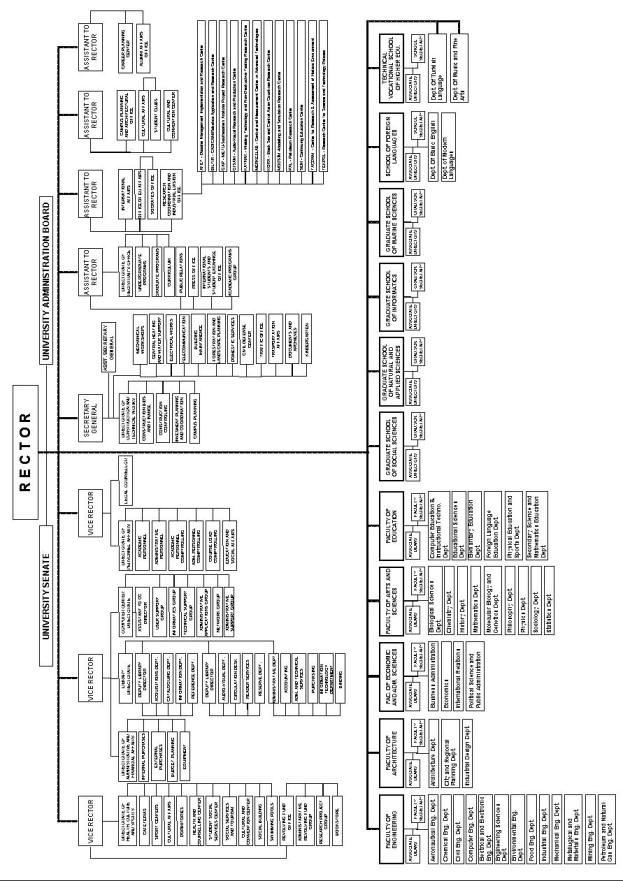
The University Organization Chart can be
seen in Appendix 17.
As of the end of 2001, a total of 2,402 academic personnel are employed
by the university. 54% of these are research assistants, 17% instructors, 7%
assistant professors, 6% associate professors, and 16% professors. The
distribution of academic staff to faculties is as follows: 46% in Engineering,
28% in Arts and Sciences, 9% in Architecture, 9% in Economics and
Administrative Sciences, and 8% in Education.
a- Distribution Across Levels
A total of 19,232 students are registered for 2001-2002 academic year at
METU. 75% of these are enrolled in undergraduate programs, 17% in master’s
programs, 6% in PhD programs and 2% are special/visiting students.
The total number of international students is 901 in the 2001-2002
academic year.
The total number of graduates (including those of the Vocational School)
was 2,537 in the academic year 2000-2001. In addition, 547 students received
M.S. or M.A. degrees and 72 received PhD degrees, in the same year.
METU is highly preferred by students taking
the Central University Entrance Examination for university education. The
University admits students from the top 1%, mostly to popular engineering,
natural, social and administrative science programs. In the years 2000 and
2001, approximately 40% of the students ranking in the first 1,000 on the Central University Entrance Examination in
all score types preferred METU. Further details are included in Appendix 4.
b- Distribution Across Faculties
For the 2001-2002 academic year, the distribution of undergraduate
students across the faculties is as follows: 49% in Engineering, 18% in Arts
and Sciences, 15% in Economics and Administrative Sciences, 13% in Education,
5% in Architecture, and less than 1% in Vocational School.
For the same academic year, the distribution of graduate students across
graduate schools is as follows: 67% in Graduate School of Natural and Applied
Sciences, 27% in Social Sciences, 5% in Informatics and less than 1% in Marine
Sciences.
Graduates from master’s programs had the following distribution in the
2000-2001 academic year: 69% from the Graduate School of Natural and Applied
Sciences, 24% from Social Sciences, 6% from Informatics and less than 1% from
Marine Sciences. On the other hand, during the same period, the distribution of
graduate students in PhD programs was as follows: 79% in Graduate School of
Natural and Applied Sciences and 21% in Social Sciences. Further details are
included in Appendix 4.
c- Trends Over The Last Five Years
Over
the years, the student enrollment has steadily increased to 19,000. Having
considered the employment figures, infrastructure, and the efficiency of the
departments, successful steps have been taken to keep the undergraduate quota
in order to emphasize to graduate studies. As it is seen in Appendix 4,
the undergraduate enrollment has declined from over 16,000 to 14,400 in the
last five years. On the other hand, the graduate enrollment has reached 4,413
showing an increase over 30%.
From
1995 to 1998, the total incoming undergraduate quota announced by the Student
Selection and Placement Center fluctuated between 2,410 and 2,445 students.
However, the increase of the quotas in the last two years, the Amnesty Law
implemented in 1999, and the onset of nationwide vertical transfer application
from vocational schools have once more disturbed the general trend, yielding an
increase in the undergraduate enrollment in the 2000-2001 academic year.
The
total number of academic staff, including research assistants in the university
has increased from 1,967 to 2,402 (more than 22%) from 1998 to 2001. The
distribution of academic staff across cadres and faculties has not changed
considerably over the last five years, except for the number of research
assistants which has increased 50% during the same period.
The
enrollment of international students has been decreasing since 1989, mainly due
to the reduction in the student quotas in those departments with a high demand.
With a 36% decrease in the last twelve years, international students now
constitute 4.8% of the total enrollment, while the ratio a decade ago was
around 7-8%.
The
students per faculty ratio has been slightly decreasing since 1995 due to the
increase in the number of faculty (Appendix 4).
METU derives about 65-70% of its total annual budget from government
funding. Table 1 provides the annual distribution of funds by source
for the period 1998-2001.
Table 1 - Revenues of METU by Source: 1998-2001 ($1,000)*
|
Source
of Funding
|
1998
|
1999
|
2000
|
2001
(est.)
|
|
Annexed Budget – Salaries
|
30,095
|
32,088
|
37,781
|
21,024
|
|
Annexed Budget – Other current
expenses
|
6,144
|
6,385
|
6,752
|
4,244
|
|
Annexed Budget – Infrastructure
|
6,723
|
6,862
|
7,001
|
4,529
|
|
Tuition Fees
|
5,602
|
5,503
|
5,780
|
4,003
|
|
Rentals and Service Charges
|
2,958
|
3,240
|
3,559
|
2,399
|
|
Revolving Fund
|
5,886
|
8,444
|
9,104
|
5,110
|
|
METU Development Foundation
|
317
|
1,270
|
7,426
|
1,268
|
|
Other Sources **
|
1,709
|
1,600
|
1,900
|
3,828
|
|
Total
|
59,434
|
65,391
|
79,304
|
46,404
|
* Based on the parity as of July 1st of each year.
** Includes donations earmarked for specific construction projects
Funds from research projects that do not cover wage/salary payments to
the university staff (such as NATO, Turkish Scientific and Technical Research
Council sponsored projects) are not included in the table. These projects do
not pay overhead to the University, but they do contribute to the
infrastructure (machine-equipment park).
METU is attracting the top quality students of the country, a strength
that has created prestigious alumni to act as a powerful strategic ally for
METU in its quest for excellence. Although it is difficult to retain the
existing cadres and attract qualified personnel due to low salaries, the highly
qualified and dedicated academic and administrative staff are still a major
strength of METU. These strengths contribute jointly to build the METU culture
and spirit, valuing organizational commitment, quality orientation, innovativeness,
and social responsibility.
The informal and non-hierarchical approach
in academic relations fosters accessibility, transparency, and participation.
However, the current administrative setup is overloaded by the volume and
diversity of activities on the campus. Various rules and regulations
constraining the administrative model, human resources and financial management
practices inhibit effective and efficient operation on the campus. Furthermore,
the eroding salary levels and promotion scheme emphasizing research and
publication result in the reluctance of faculty to devote time to institutional
development projects, administrative, and committee work.
METU`s claim with regard to
internationalization is supported by memberships in numerous international
scientific and professional networks, primarily in English-speaking countries.
However, the weak ties with its European counterparts need improvement.
Despite the intention of stressing research
activities, the university culture and practices still favor undergraduate
education over graduate studies and research. Furthermore, conservative
attitudes of some faculty hinder the development of new courses and changes in
curricula.
The major physical asset of METU is the
attractive campus with buildings and abundant space for education, research and
social and cultural activities. Nevertheless, most buildings and technical
infrastructure are aging and increasingly in need of extensive repair and
maintenance.
Financial support from the METU Development
Foundation and other sources compensate, to some extent, for the insufficient
state funds needed to maintain a research university of international caliber.
The Rector, Secretary General, Vice Rectors, Assistants to Rector,
Deans, Directors of Graduate Schools, Department Chairpersons and the governing
boards at various levels in the University constitute the major bodies
responsible for the strategic management and overall functioning of the University.
The
heads of the academic units, with whom ultimate decision-making power rests,
are advised by the academic and administrative boards. The academic boards make
strategic decisions, while the latter are responsible for the day-to-day
implementation of rules and regulations. Although the University Senate and the
boards are, in general, advisory in nature, the Rector, Deans, Directors and
Chairpersons often delegate decision-making power to these bodies.
The boards at the University, faculty and
graduate school levels consist of elected and ex-officio members. The
department academic boards consist of all the academic staff in the
departments. The student movements during the period of 1972-1980 had a
consequence on the relevant law to exclude representatives of the students or
administrative staff from any of these boards.
There are no lay members, in the Senate or the
various boards of the state universities. The only potential source of external
influence is the lay members of HEC. However, hidden or indirect governance
stems from the public finance laws, which stipulate in minute detail the
procedures to be followed in the preparation of annual budgets, procurement
(including construction contracts), and auditing of expenditures, to which all
public agencies are subject.
Procedures
governing the election, nomination and appointment of the Rector, Deans,
Directors and Chairpersons and the requirements thereof, as well as the
composition of the boards and the responsibilities and authorities of each, are
given in the Higher Education Law in Appendix 14.
Major decision making processes of the University can be considered with
regard to three main activities: Education,
including curriculum development, course delivery, assessment of learning and
extracurricular activities, establishment of new departments and schools; Research, including projects,
establishment of laboratories and centers; and Administration. Decisions
concerning these activities are distributed to the following university organs:
The major research and educational activities are discussed and decided
by the department academic boards. Most of the time, the proposals come from
the individual efforts, without utilizing a formal measurement and assessment
process. However, some academic and administrative committees in the
departments conduct studies taken into account by the academic board when
making decisions.
Each undergraduate and graduate student is assigned an academic advisor in
the department who monitors the performance of the student and approves the
courses taken each semester. However, advisors’ role significantly decreased
with the online registration system and has almost been reduced to automatic
approval of the courses the student intends to take.
At the faculty level, the
decisions are taken by the Faculty Board and Faculty Administrative Board,
chaired by the Dean. The faculty boards approve the decisions which come from
the departments in order to coordinate the undergraduate education and
administrative activities within the Faculty.
The director of the graduate school chairs the
academic and administrative boards of the graduate school, which approve and
organize graduate programs.
The director of the research center is responsible for the research and
administrative activities. The center boards monitor the activities of the
center to provide advice to the director in regular monthly meetings.
Major university organs responsible for strategic decision-making at the
top level are the University Senate and the University Administrative Board,
headed by the Rector. While the Senate is basically responsible for the
decisions concerning evaluation and establishment of institutes, research and
development centers, and graduate and undergraduate programs, the University
Administrative Board makes decisions about day-to-day administrative
activities.
Administrative management decisions, regarding public relations, student affairs, health services, community services, cultural
affairs, physical resources and budgeting are made by the responsible Vice Rector or Assistant to Rector and/or
Secretary General and approved by the Rector. The decisions are implemented by
the central administrative offices. Some examples are given below:
First and foremost care is devoted to continuous and systematic
promotion of the University to attract high quality undergraduate students. The
Public Relations Office under one of Assistants to the Rector, in coordination
with a committee especially set up for this purpose, participates in national
fairs and organizes departmental promotion programs designed for high school
students providing them with basic information concerning professions.
The Registrar’s Office, reports to one of Assistants to the Rector and
deals with all student-related administrative issues. The great majority of the
procedures are automated through a
Student Affairs Information System that allows students to register for
courses and review their grade reports, and allows instructors to submit grades
through the Internet.
The Student Clubs, under the responsibility of the Office of Cultural
Affairs and the Office of Health, Culture and Sports, organize various cultural
and artistic activities throughout the year. These activities are carried out
under the control of an academic advisor and supervised in accordance with the
decisions of the executive boards of the Clubs.
A special committee organizes fund raising activities for scholarships
for students with financial difficulties. Approximately 4,000 undergraduate
students benefit from the financial support provided by METU sources and
institutions outside the University. Furthermore, METU provides scholarships to
students with outstanding academic performance (Appendix 5).
A multi-disciplinary standing Library Committee of academics is designed
to reflect the needs of university users in the development of library services
and collections. The University Library and Documentation Center is undergoing
a major change, as a formal and comprehensive strategic management and
performance budgeting system is being implemented for the first time in the
University. In addition, the METU Library has a leading role in the
establishment of a successful national consortium of university libraries,
ANKOS (Anatolian Libraries Consortium) (Appendix 7). Similar to the
practices of the Library Committee, the multi-disciplinary Computing and
Informatics Committee, develops strategies and policies, and approves annual
investment budgets regarding the University computing and communication
infrastructure (Appendix 8).
The Directorate of Construction and Technical Works and the offices that
are related to the duties concerning the campus and infrastructure support are
in charge of the management, maintenance and construction of physical resources
and are responsible to the General Secretariat. The Directorate of Construction
and Technical Works provides architectural, interior and engineering designs,
and estimation and management services for all projects. It is also the duty of
this Office to manage the coordination of new constructions as well as projects
involving certain space-based changes in the University. Planning of the major
projects and funding considerations are carried out by the Rector's Office.
In the domain of Community Services, METU has a vast number of
activities at all levels of the university, under foundations, associations and
committees. Among them, the most important ones are rehabilitation activities
after the devastating 1999 earthquake, organization of disaster management in
co-operation with local governments, establishment of primary and secondary
schools, and provision of equipment and books to primary schools in rural
areas.
Decision Making Processes for
University Budget Proposal Development and Budget Allocation
The annual annexed budget proposal is compiled
by the Rector’s Office and approved by the University Administrative Board,
following the procedure summarized below:
·
The University utilizes an equation for each line-item in the other
current expenses budget proposal. The formulae, which were developed by an
interfaculty Budget Committee, are devised by using criteria such as number of
students and faculty members and special needs of different units.
·
The Rector’s Office prepares the infrastructure budget proposal, which
incorporates construction, large-scale repair and maintenance. The
priority-ranking of each infrastructure project is negotiated between the
Rector’s Office and the concerned units. Moreover, each year academic and
administrative units submit and negotiate with the Rector’s Office, their
proposals for specific sub-items in the current expenses budget proposal, as
well as any anticipated activity that will require resources beyond what the preset
criteria would provide.
·
The
annual funds allocated by the government usually fall short of the proposed
budget figures. The distribution of the approved current expenses budget to the
academic units is adjusted by the Rector’s Office to reflect the proportions
suggested by the formulae used in preparing the original proposal. Both the
budget proposal and the final allocation of the approved budget funds must be
approved by the University Administrative Board. Due to the reluctance of the
Ministry of Finance to approve substantive changes in the line-distribution of
the budget from one year to the next, the current expenses budget is slow to
respond to the changing needs and priorities of the University. The University
has higher discretion in transferring funds among infrastructure projects, once
the State Planning Organization approves the budget.
·
Faculties and graduate schools receive 3% of the budget of contract
research projects carried out by their faculty as discretionary funds, while
10% is allocated to research funds. Moreover, a very substantive part of the
share at the disposal of the Rector’s Office (5%) is again allocated to
faculties and graduate schools to finance travel expenses of their faculty
members. The remaining part of the share of the Rector’s Office is used to meet
the needs of the administrative units or the common university infrastructure.
·
The student tuitions, rental fees and other revenues, administered by the
“Student Social Services Accountancy (SSSA)” provide more substantial funds
left to the discretion of the faculties and graduate schools to meet their
machinery and equipment needs, as well as providing considerable support for
the information services of the University. Moreover, the University has more
leeway in allocating the SSSA funds in line with its priorities, such as
subsidizing student dormitories and food services, and bolstering student
scholarships and financial aid.
·
The METU
Development Foundation has greatly helped in generating the funds for and
managing some of the University’s strategic projects, such as on-campus faculty
housing, dormitories (Appendix 6), METU-Technopolis, as well as
providing financial support for research.
·
The University
has no control over salaries.
The first comprehensive study to set forth the strategies of the
University was prepared for the 1995-2000 period and has been updated to cover
the 2000-2005 period (Appendix 3). However, these studies are not
complemented by strategic and operational plans. Academic and administrative
units do not have long term plans beyond annual budgets. This is caused partly
by the turbulence in METU’s environment, and partly by the “informal”
management traditions and practices.
METU has relied
extensively on informal communication channels and face-to-face interaction
which have provided the departments and faculties with almost complete freedom
on academic issues, as well as considerable discretion in resource allocation.
The fact that the Rector is elected by the faculty, provides legitimacy and
support to the Rector as the main strategist and agent of change. The Rector’s
Office has been able to initiate and carry to completion very substantive
changes in the University (e.g., academic promotion system, and overhaul of
curricula designs). The process is usually lengthy with iterations and
negotiations at different levels, and involves active participation of the
faculty and academic administrators.
Some of the major decisions with long term and far-reaching impact on
METU, such as the establishment of the Faculty of Education, the Vocational
School, and METU Northern Cyprus Campus, have been initiated externally. On the
other hand, major choices, such as reducing undergraduate enrollment in favor
of graduate enrollment, decreasing undergraduate quotas of “less demanded”
departments and increasing quotas of “more demanded” departments, have
developed internally. Moreover, METU has pioneered in introducing several major
innovations, e.g., non-thesis master programs, abolition of divisions within
departments, thereby influencing improvements in the higher education system by
working closely with HEC and other universities.
The data collection and
reporting activities at METU may be classified into three groups:
1. Automated data collection
and reporting: The accounts of the University are fully automated to allow real-time
data updating and reporting. Transaction data and reports are accessible to all
academic and administrative units through the Intranet.
An automation process is underway in the Human
Resources Directorate utilizing the Oracle integrated package.
2. Periodic data collection and review: The University
collects data and compiles reports periodically to include:
·
Annual Progress Reports of academic and administrative units
·
METU Annual Progress Report
·
Academic Staff Performance Data
·
Student Evaluation Surveys of courses and instructors on a semester basis
3. Aperiodic/unstructured data
collection and feedback: In addition to daily informal face-to-face contact
among the staff, the University maintains several general and specialized
e-mail lists and groups on the Internet that are very intensively used by the
faculty and administrative staff. These groups allow staff to share their
observations, opinions, and requests or to air complaints about a wide range of
issues from physical amenities and university promotion criteria to a new world
order.
There are intermittent activities undertaken
by the University or subunits to obtain data and feedback from the external
environment. They include:
·
Annual or semi-annual meetings with the Alumni Associations with the
participation of the Rector and Vice Rectors
·
Surveys conducted by the Career Planning Office to elicit opinions and
suggestions from industry regarding METU programs and graduates
·
Surveys carried out by the academic units to get feedback from alumni and
industry as a part of curriculum review and development activities
·
Contact with alumni through e-mail groups
However, as the University does not have a
comprehensive and structured system of performance criteria, data collection
and reporting mechanisms do not form a coherent and integrated framework.
During the transition from the growth to the maturity phase, the
informal information channels which flourished in the METU culture, have
started to lose their effectiveness.
Furthermore, the various rules and regulations accentuating centralization
disturb the participative approach which has been a major strength of METU.
Currently, the University is overgrown with informal mechanisms to
reestablish the articulation of vision, mission, and related objectives of the
University, as well as mechanisms for strategic analysis, strategy formulation,
and implementation. The absence of plans and criteria for efficiency and
effectiveness measurement are the major weaknesses of METU, leading to a lack
of coordination between the academic and administrative units. In order to
compensate for this deficiency, ad hoc data collection, and information
circulation and dissemination processes are employed for adapting the
environment.
The METU Career Planning
Center is the first of its kind established in Turkey and has led the way to
the creation of similar centers in other Turkish universities. Owing to close
communication ties and good relations with companies, along with activities
such as the “career days” and organization of career fairs, each year it has
provided more than half of its graduates with employment opportunities. Every
five years, the Career Planning Center conducts an extensive survey on the
performance of METU graduates, by means of questionnaires addressed to the
companies which employ them. The survey in 1998 resulted in the addition of
further English and writing skills courses to the curriculum and the
introduction of a long-term summer practice program (COOP) in some departments.
The Alumni Office that works under the Career Planning Center strives to
contribute to the opening of fresh job opportunities for new graduates and to
collect donations for the university by maintaining close contacts with METU
graduates, especially with those who have been successful in business life. The
Alumni Office also collects feedback from the meetings held frequently with
alumni associations in 12 provinces of Turkey and is in continuous contact with
10 alumni organizations in 7 countries abroad.
3.2.2
The Balance Between Undergraduate/ Graduate/Continuing Education
The University has a target of keeping the
undergraduate enrollment at the level of 12,000 and increasing the graduate
enrollment to about 5,500 by the year 2005, yielding a graduate student body of
27% at METU. For this purpose, new and interdisciplinary programs in the
graduate schools are encouraged, with special attention devoted to on-line
graduate programs. Furthermore, around 200 research assistants, employed in the
cadres of the developing universities, do their PhD studies at METU, with an
obligatory agreement to serve in their universities subsequent to the
completion of their studies at the university.
3.2.3
Internationalization of Education
METU was established as an international university to provide technical
human resources for the Middle East region by means of its highly qualified
staff mostly holding PhD degrees from well-recognized universities abroad. Up
to the 90s, international students accounted for 7-8% of the total enrollment.
However, in recent years, a decline in the number of international students has
been observed.
METU has 94 collaboration and exchange agreements with institutions in
36 countries (Appendix 10). Furthermore, since 1993 exchange students have
been accepted and also sent from Turkey. An International Summer School and
preparations for a Diploma Supplement and the European Credit Transfer System
(ECTS) within the framework of the Erasmus Program have been launched to
increase the student exchange rate.
During 2001, intensive efforts have been spent to develop joint programs
with the State University of New York (SUNY). It is foreseen that students
participating in these programs will be able to take the courses offered in
these programs during the summer months at relevant SUNY campuses and that some
courses will be taken via distance education.
The METU Northern Cyprus Campus, expected to accept students at the
beginning of the 2003-2004 academic year, will also contribute to the
internationalization of the university.
To increase the number of international students, both on the main and
Northern Cyprus campuses, more emphasis will be given to the promotion of METU
in the coming years, by increasing the amount and types of materials to be sent
abroad, participating in international education fairs, and establishing
stronger ties with Turkish embassies and organizations outside Turkey.
As Turkey is planning to participate in European Union Education and
Youth Programs in 2003, an Office of EU Affairs was set up in October 2000. The
aim of the Office is
·
to keep close
track of innovations and changes in the EU education programs (Socrates,
Leonardo and Youth),
·
to give
technical support to the faculty to enable their participation in EU projects
both at the planning stage and when ready to be implemented as a whole or in
parts,
·
to be in touch
with the relevant EU institutions and joint foundations that are influential in
the relations between Turkey and the Member States.
However, the Office is confronted with some obstacles in realizing these
aims: the Turkish National Agency, which is expected to play a leading role in
establishing the ties with the EU as an official body, has been set up very
recently and has not yet fully completed its infrastructure. Furthermore, a
lack of interest among some academicians in conducting joint research or
projects with the Member States is a hurdle yet to be overcome.
3.2.4
Application of ICT to Education, Research, Administration and Information
Services
METU started building up a computing capacity for education and
research, and the automation of the financial and administrative activities as
early as 1970, with the establishment of the Computer Center. Since then,
advances in information technologies are continuously incorporated to construct
and link the building blocks of the ICT in an iterative manner. Currently, the
information systems covering student affairs, accounting, resources management,
library, online grading and registration are important modules of the ICT at
METU. Although the systems provide some means of obtaining information, there
is no systematic effort to improve the information required for strategic
management.
The computing power for activities concerning research and education is
decentralized through the local area networks on the campus.
Quality of education and research is monitored at the university and
faculty administration levels by using the following tools:
1. Student Evaluation Questionnaires, which are filled out by the students for each course at the end of
each semester, are taken into consideration for promotions and awards.
2. Faculty Performance Assessment Questionnaires are filled out by the faculty to indicate
their education, research and administrative performance. The data are kept
confidential. However, it is used in preparing the Yearly Activity Report of
the University.
3. METU has its own set of Criteria for Promotion (Appendix 15), devised by the
University Administrative Board. Juries are formed to review the
academic promotions of the faculty.
The high demand for METU programs is considered to be an indicator of
the quality of education. Although the Career Planning Center and departments
conduct alumni surveys, satisfactory comprehensive feedback could not be
gathered so far about the short-term and long-term success of METU graduates in
the labor market, or about the appropriateness of curricula in general.
The quality of educational
programs is monitored and procedures for departmental improvement proceedings
are planned by the departments. The Education Committee evaluates departmental
proposals for new courses and for changes in curricula. The Committee typically
lacks a systematic analysis of targets versus achievements and may be too
involved in short term problems and resolutions. The coordination among
different faculties or schools is a major quality problem that has not been yet
effectively solved.
Research Centers monitor their own research performance. Although the University
upper administration promotes quality research, it does not play an active role
in monitoring the quality and taking corrective action against poor
performance.
Support services such as computing facilities and the library write
annual activity reports and present these orally to the University upper
administration. For the time being, complaints from these services are taken as
indicators of quality.
The present informal quality assurance system implicitly results in a
high success rate in education and maintains the academic quality of the
faculty. However, evaluation of research quality and monitoring the performance
of research centers are not structured. Availability of international funds as
a natural outcome of the preparation period for accession to the European Union
is expected to guide the procedures to monitor research quality.
Although there are various boards and committees to assist Chairpersons,
Directors, Deans and the Rector by discussing the quality of education and
research, there is no attempt to assure the effectiveness and efficiency of the
support services given at METU. Also, the students are not involved in any
phase of decision-taking and implementation.
During the ABET
accreditation process, most departments in the Faculty of Engineering defined a
set of measurement and assessment processes in order to evaluate the
effectiveness and outcomes of their curricula. A similar effort is needed in
other academic units of the University, not only with regard to education but also
to activities concerning research and administration.
Creating feedback loops to incorporate student evaluation has not been
systematized. The student questionnaires are mostly used to evaluate the
teaching quality of academic staff. To summarize, quality monitoring is a
common problem at different stages. A qualitative evaluation system that
matches the long-term plans and evaluates target-based achievements would be a
great contribution to the quality assurance of the university.
The management of change is realized through both top-down and bottom-up
approaches at METU. The major top-down change agent is the Rector himself
together with Vice Rectors and Assistants to Rector. However, he has a limited
power in strategic changes related to budget allocation, personnel policies,
and large investments, due to constraints imposed by the Higher Education Law.
Bottom-up change processes which are essentially related to the changes
in curriculum and course conduct are initiated in the Department Academic
Boards at the lowest level. The suggestions for change in curricula are
submitted to and approved by the Faculty Board. The departments are quite
autonomous in managing the changes related to academic and administrative
issues, as long as they are consistent with the general strategies and policies
of the University. The major change agent at the bottom-up level is the
department chairperson.
The imposed increase in the student numbers results in an ad hoc
expansion in the infrastructure and personnel of the University. The current
size and capacity of the University necessitate the design of a thorough
quality assurance and change management mechanism.
To overcome the major
weaknesses in change management, METU is launching a process of redefining its
mission, objectives, and strategy setting and selection mechanisms. This
process is intended to be dynamic, self-enhancing, bottom-up, and participative
as in the initial planned growth era of the University, nevertheless it will be
reinforced with formal feedback and corrective mechanisms.
The statement of 2000-2005 METU Development Targets and Strategies is
intended to be the starting point of the new strategic policy making process,
rather than a final declaration of the University’s mission, related goals,
objectives, and strategies. The strategic policy making process is envisaged to
take its momentum from self-assessment by departments, faculties, institutions
and centers of the University, which involves the following steps:
To start with, each academic unit questions the
reason for its existence, that is, what its mission is, what its goals and
objectives are, how it is to achieve these, how much its objectives differ from
those of its competitors, who its stakeholders are, what its expectations are.
In the forthcoming stages of the process, the academic and administrative units
assess how their goals, objectives and strategies relate with and integrate
into that of the University. Then if need be, amendments are made and necessary
measures are taken by individual units to achieve their objectives. During the
following stage, each strategic unit develops the criteria and measures to
initiate the self-assessment process. Finally, administrators of each strategic
unit, having questioned the results of the self-assessment, choose its
individual strategy and facilitate the corrective action.
At the end of every cycle of performance measurement, estimated to take
2 years, a new cycle will be triggered whose starting point will be the
assessment results of the previous cycle. With the help of this process, every
aspect of the units will be questioned, based on the results of the previous
cycle, and the required changes will be made. Thus, it is intended to serve as
a kind of learning system which improves and renews itself with what has been
learned, encouraging full participation and consensus of the major
stakeholders.
In order to maintain sufficient detail conducive to policy generation
and specific action, the confrontation matrices provided in Appendix 18
were created in connection with specific higher-level objectives of the
University. While the SWOT items included in these matrices comprise an
extensive list, certain headings emerge as underlying or common factors.
The major assets that distinguish METU, and serve as its sources of strength
appear to be:
·
The "METU
image", referring to the reputation and trust inspired in, and support
received from the society as a high-quality, dependable, and principled
institution with a pioneering role;
·
Its qualified
faculty of international caliber, demonstrating a high degree of institutional
commitment;
·
A select
graduate and especially undergraduate student body;
·
An
organizational culture that is quality-oriented, tolerant, and supportive of
self-actualization, cognizant of developments, and open to change;
·
Strong
international contacts in several teaching and research networks, English as
the medium of instruction, and reputation as a prominent regional university
with internationally accredited programs and world-class graduates;
·
Its land area
and building stock, as well as the wealth of social and cultural amenities
provided on the campus;
·
Its
laboratories, ICT infrastructure, and library facilities sufficient for
teaching and most research needs;
·
A leading
position in contract research, university-industry collaboration including METU
Incubation Center and METU-Technopolis.
The weaknesses that encumber METU are attributed to:
·
Insufficient
state funds to support the existing infrastructure and research needs;
·
Being a state
university subject to a legal framework that constrains METU's ability to
generate and use resources effectively;
·
Aging faculty
and weakening administrative staff caused by low salaries making it difficult
to retain the qualified human resources or to attract equally qualified new
staff;
·
Worsening
personal finances of University personnel, creating motivation problems, and a
push for revenue-generating activities that compete for faculty time and energy
available for research and teaching;
·
An
organizational tradition emphasizing undergraduate education and lack of
mechanisms to prioritize research and graduate education;
The SWOT analysis identifies a set of opportunities that may benefit
METU in fulfilling its mission:
·
Growing demand
in Turkey and abroad for highly qualified graduates;
·
Increasing
need for graduate-level education brought about by the demand for faculty
members in the newly-established Turkish universities;
·
Recent steps
taken in national politics to provide more support to the education sector and
empower state universities to a larger extent in financial management and
administrative issues;
·
Advances in IC technologies;
·
Rising interest in Turkish industry to collaborate with universities and
support R&D activities;
·
Recent international
events emphasizing Turkey’s regional and international position and attributing
new roles;
·
Strengthening
international academic/scientific networks and collaborative mechanisms,
notably those involving European countries.
A sizeable list of threats were also identified by the SWOT
analysis:
·
Frequent
fiscal/economic crises depriving the University of the funds needed to keep up
with the demands of up-to-date research and teaching;
·
Increased
competition from universities abroad primarily for qualified graduate students
and researchers;
·
Inaction by
the authorities to improve salaries of METU personnel to result in continued
and even accelerating "aging" and erosion in qualified academic and
administrative personnel;
·
Isolationist
tendencies in the national political arena and uncertainties in Turkey's
international relations;
·
Uncertainty in
state priorities and policies regarding higher education in general, and
R&D in particular;
·
Increasing
competition in Turkey for qualified students, academic and administrative
personnel and research funds with the emergence of private universities;
·
Uncertain
nature of R&D demand of Turkish industry;
·
Difficulty in
attracting sufficient numbers of qualified graduate students to support the
demanding graduate programs (especially PhD programs) METU offers
The findings of the SWOT analysis point to a set of high-priority challenges
for the University:
·
Improving
personal financial means of University staff: The University has indirectly contributed to the personal finances of
its staff by constructing housing for faculty and administrative personnel,
maintaining contacts with the government and campaigning in mass media for
increased salaries for state university personnel, and providing merit awards
and supporting faculty publications.
·
Increasing
the financial resources of the University in general: The University has maintained and tried to
strengthen its contacts with the state agencies for increased funding, expand
METU Development Foundation companies and investments to provide constant flow
of revenue for the University, develop alumni fund-raising campaigns, establish
collaboration or alliances with organizations at home and abroad to procure
research and infrastructure funds, expand continuing education and evening
degree programs to support tuition receipts, and contract research activity
under the Revolving Fund.
·
Advocacy
and support for change in the legal framework to empower the University: METU has played a leading role in bringing
the problems of state universities to the attention of the government,
parliamentarians, and high level bureaucrats; organized public relations
campaigns and media appearances, and established alliances with other state universities
to advocate the necessary legal changes, and actively participated in
preparation of some key legislative amendments.
·
Improving
collaboration with industry to support R&D activities: The mission of METU calls for more effective
collaboration with the key sector in the economy to further improve its current
cooperative agreements for joint research, METU-Technopolis, revolving fund,
and special purpose training and degree programs.
·
Increasing
the input of qualified undergraduate and graduate students: Continued promotion efforts aimed at high
school graduates, as well as scholarship and accommodation for qualified
students, and cooperation with state universities in the area of graduate
education appear essential for realizing METU's objectives.
It is in this light that the five high-priority objectives of the
2000-2005 period, as explained in "Section 2.1 Mission Of METU",
embody clusters of projects to meet the above-mentioned challenges.
As seen from this brief
exposé, METU has been proactive to a large extent in formulating conscious
strategies to respond to the threats and opportunities in its environment.
Hence, in strategic management parlance, METU has displayed leadership skills
to adapt to the rapidly changing conditions in its environment, and
actively participate in efforts to modify its legal environment. However, the
University does not have a formal and structured "strategy formulation and
review" procedure; traditionally, the process, governed by the Rector, is
mostly informal, judgmental, and at times fragmented. Formal procedures of
strategy formulation and review, such as environmental scanning, strategic
needs assessment, and strategy audit are not commonly utilized.
Moreover, the "strategy documents" specifying university-wide
mission(s), objectives, and high priority projects, are not translated into
formal and explicit university-wide administrative- and operational-level
plans. The University does not produce comprehensive and formal plans to
coordinate and mobilize its financial, human, and physical resources in line
with the University objectives formulated. This is due, in part, to the
"informal" and "negotiation-oriented" management culture at
METU, and also to administrative- and operational-level "inertia"
caused by inflexible administrative structure dictated by the legal framework,
scarcity of strategic resources and discretionary funds available to University
administration, and traditional METU culture which emphasizes consensus and
gives large degrees of autonomy to academic units. Academic and administrative
units do not have formal and communicated plans, save for annual budgets that
conform to the guidelines indicated by the University-wide objectives. Hence,
again in strategic management parlance, there is a need for management skills
and formal tools to better communicate and coordinate, that is to integrate,
the priorities, resource allocation decisions, and activities of academic and
administrative units within the University.
It is, thus, a management
challenge to implant a coherent strategic management model and develop an
effective system of unit- and University-wide strategic plans. It is
anticipated that such a model will improve rationality, transparency and
accountability, as well as providing a medium for effective communication and
participation in the decision-making processes. While periodic documents, such
as the METU Annual Progress Report, are already being compiled to reflect
institutional performance in terms of the most generic performance criteria, it
is only by means of coherent and communicated strategic plans that a consistent
and comprehensive system of performance criteria may be developed to measure
efficiency, effectiveness, and productivity. Such systematic performance
measurement and evaluation will provide the necessary feedback for (strategic)
resource allocation decisions, as well as serving as a sound basis for
modifications needed at the strategic, administrative and operational levels.
This transition, as it requires organizational learning, will inevitably
take time. Self Assessment Committees (SEC) will provide the important first
step to assess the strategic needs and formulate the strategic priorities of
academic units. Moreover, the experience obtained from the strategic management
and performance budgeting pilot implementation at the METU Library will
contribute to this learning process. The challenge, then, facing METU is to
design and manage the process of moving from a large organization with
centralized strategic decision-making and informal integration mechanisms to a
more adaptive university with mutual goal setting by it units, integrated more
effectively around the institutional mission and objectives.
1. Consolidation of METU
as a Research University of International Recognition: The University aims to be a dynamic institution
seeking excellence in an international context. To this end, it strives to
attain the required status by attracting the best teaching and research staff
and the highest quality students as well as providing best service with the
contribution of its highly qualified administrative and academic staff.
2. Academic Human Resources Development: The University gives priority to research
by encouraging its student body to enroll in graduate and especially PhD
programs, where graduate and PhD theses are expected to be as interdisciplinary
as possible, based on national and international projects, with the ultimate
goal of offering solutions to the problems of the society and humankind and
filling the gap for scientists.
3. METU-Technopolis and Incubation Center (TEKMER): The University strives to form a research
structure integrated with the regional and external sectors and to take
measures for the development of METU-Technopolis and the Incubation Center. The
University aspires to contribute to the technological innovations and
productions by directing graduate and PhD theses towards METU-Technopolis and
the Incubation Center and to establish a healthy and productive structural
relation between the University and these two centers.
4. Distance Education:
METU intends to initiate various degree and certificate programs using distance
learning methods based on the Internet. The University is ready to assume a
leading role in national and international activities in this area and to
develop joint distance education programs through cooperation with national and
international bodies.
5. METU Northern Cyprus Campus: The University aims at developing the METU Northern Cyprus Campus on a
sound structure, setting up academic programs and discuss various
administrative and academic matters in detail with the participation of the
entire faculty. The University wishes to maintain these in close contact
between Turkey and the Northern Cyprus.
1. RESEARCH
The basic aim of research carried out at METU is to contribute to
science at both national and international levels and to offer solutions to
technological, economic and social problems. To this end, to provide research
and education in a balanced way, taking into account the diversity in various
fields at METU and supporting research and publications in areas that need
betterment and recovery in Turkey constitute the basis of this strategy.
The targets and strategies to achieve the above mentioned aim are as follows:
1.1 TO
DEVELOP R&D ENVIRONMENT
·
To form the
University research inventory
o By formulating project inventories and
interest areas of the faculty within scope of national and international
research, by way of defining the strong and weak areas and accordingly coming
up with improvement mechanisms.
o By preparing a catalogue involving
information on the areas of interest of the faculty and projects carried out at
METU and by publicizing this catalogue on the Internet
·
To advance
access to research funds and to use them efficiently
o By informing the university faculty on
national and international research programs and available funds to increase
applications to national and international research programs and to enable them
to benefit from the funds in the best way possible.
o By focusing on project groups such as the
State Planning Organization and the Turkish Scientific and Technological
Research Council at home and EUREKA and EUMEDIS abroad and by providing the
impartial distribution of such projects.
o By accelerating the practices promoting the
research potential of the University
o By setting up mechanisms providing support
for the faculty wishing to prepare research proposals
·
To improve
the methods applied for the evaluation of applications and progress reports in
order to use of research funds efficiently
·
To form
effective and efficient project development structures in the units established
to carry out interdisciplinary research
o
By defining long, medium
and short term targets and strategies of the research and implementation
centers and working on action plans to achieve them
o By creating resource through the use of
knowledge and technology produced and by supporting the use of it to boost the
research potential of the University
- By
encouraging the academicians to participate in the organization and
supervision of projects at research centers and by establishing
mechanisms to create resources for research projects
·
To adopt
and encourage the widespread use of research culture
- By
preparing documents providing research support to graduate students
- By
creating an environment for discussion on scientific targets and goals of
undergraduate, graduate and PhD programs in the faculties, departments
and centers at METU
- By
increasing the number of observers present at thesis presentations and
juries
- By
increasing the number of research seminars organized both within the
University and outside
- By
creating funds to invite speakers and getting the support of the industry
·
To set up a
unit where research will be carried out on patent and intellectual property
ownership rights to be obtained as an end result of the research carried out at
the University
- By
informing the faculty and graduate students with the help of this unit
about their rights concerning the issues on patent and intellectual
property ownership to be obtained through research done at METU
o
By providing support for
graduate students on their entrepreneurial activities through which they can
have a chance to shape up their future for the years ahead.
1.2 TO STRENGTHEN
UNIVERSITY-PUBLIC INSTITUTIONS-INDUSTRY RELATIONS BY FOCUSING ON R&D
·
To aim at
high-level attempts to develop the relations between university, public
institutions and industry
·
To promote
the establishment of field committees on a sectoral basis and increase the
invitations and visits from industry
- By
following the current trends in industry and by promoting the projects
and theses carried out at the University.
o
By motivating the faculty
working in the centers and committees with incentives such as overtime and
promotion possibilities.
- By
arranging means for these academicians to benefit from the University
facilities, such as transportation and accommodation to promote the
University-industry relation.
·
To search
for resources to be used in the establishment of new laboratories and centers
in basic scientific research
- By
striving for the foundation of research units for natural and social
science research within the University premises to answer the R&D
needs of the public institutions with some contribution from these
institutions
- By
supporting natural and social sciences in an efficient way through
research funds
·
To organize
activities to persuade the industry to invest at the University for the purpose
of supporting innovations
- By
maintaining the effort to establish institutes, centers and laboratories
with the support of public and private sector enterprises
- By
developing models to increase the R&D projects
- By
supporting the public and private sector enterprises in defining their
research needs in various disciplines and by developing means to this end
- By
defining a co-operation with the public sector and industry following the
formulation of the departments’ individual methods.
·
To prepare
short and long term plans to supply the academic units with laboratory and
research tools and instruments equipped with present-day technology
·
To make
improvements in the current revolving fund regulations.
- By
searching for possibilities of changes in the legal procedures to
encourage the University faculty to participate in research projects
- By
suggesting ways of improving the regulations by reviewing the regulations
in effect
- By
reducing the University share in research projects
- By
proposing a new structure in which all departments benefit from the
revolving fund (Currently School of Foreign Languages, for instance, does
not)
·
To promote
the Incubation Center (TEKMER) and to strengthen its relations with the
University
·
To attract
national, international and multi-national R&D institutions to the
University campus within the METU-Technopolis framework
- By making
arrangements in the regulations on the personal rights of the faculty as
employees that will encourage their investment in industry and service
sectors through the METU-Technopolis activities
·
To provide the
development of METU-Technopolis in a planned and organized way
·
To make
regulations aiming at the enhancement of the present structure and relations
between METU-Technopolis firms and the faculty
·
To
contribute to the design, innovation and technology production required to
carry out various national and international projects through METU-Technopolis
·
To strive
for the legal frame of allowing the faculty spend their 7th year
leave (sabbatical) at industry or service sectors, within the framework of the
development strategies of their departments as this will help develop
technology and in this way intensify the university-industry relations
·
To initiate
projects for the intensive use of Central Laboratories by industry
·
To
encourage the preparation of graduate and PhD theses at METU-Technopolis and
the Incubation Center
·
To strive
to persuade the foundation companies to support the R&D activities in the
universities
- By
ensuring the professionalism demanded for the realization of large-scaled
projects by the foundation companies.
- By
clearly defining the procedures and principles to be applied when
projects with foundation companies are carried out
- By
directing the current foundation companies towards R&D and
establishing new foundation companies in the field of advanced technology
1.3 TO
GIVE PRIORITY TO RESEARCH IN EDUCATION
·
To increase
the number of institutes and research centers and improve their structures to
carry out both educational and research activities
- By
working on the setting up of a science center as a part of
METU-Technopolis
- By
reshaping the university structure towards a research center-based
institution
o
By organizing
interdisciplinary work in the framework of institutes and research centers and
by employing there staff who will be responsible only for research
- By
continuing the activities of the Research Fund Executive Board in a more
effective and efficient way
- By
introducing an understanding which evaluates the activities of the
faculty in the departments, centers and interdisciplinary activities as a
whole
- By
defining the appointment and criteria promotion and interdisciplinary
activities of the faculty
·
To adopt a
structure promoting graduate and PhD studies and to open new graduate programs
- By
redefining the student profiles, the need for new faculty and
infrastructure to become a university with an emphasis on graduate study
- By
formulating new regulations to enable the opening PhD programs following
the completion of undergraduate programs in keeping with the framework of
the current legal system. By doing this, to shift the research potential
from graduate to PhD theses and to answer the qualified faculty need in
Turkey, and to this end, initiate the work within the institutes
themselves
- By
inquiring the reasons for low rates of completion of graduate and PhD
programs and by taking the necessary measures to increase efficiency
- Evaluating
master’s degrees as an 'intermediate degree' achieved in one or one and a
half years as an increasing the number of programs to train experts in
certain fields and by opening new graduate programs without thesis in
these fields
- By giving
priority to graduate and PhD studies by taking into consideration issues
like the number of faculty, infrastructure of the departments, coherence
between the programs and the level of students accepted to these
programs, and efficiency of the departments
- By
providing opportunities to students to do research within the framework
of joint projects through protocols signed with universities and research
institutions abroad
- By attracting
qualified students and young researchers from abroad to carry out their
graduate, PhD and post-doctoral studies at METU
- By
increasing the number of graduate and PhD students with undergraduate
degrees from other universities to be accepted to METU and by promoting
an awareness and appreciation of the University among the graduates of
other universities.
- By
introducing evening programs in the fields where there is a high demand
using the means of online education benefiting from the Internet, and by
opening new interdisciplinary graduate programs in the light of the
developments in Turkey and the world
1.4 TO
INCREASE INTERNATIONAL RESEARCH ACTIVITIES
·
To increase
the number of joint international research projects
- By
encouraging various units of the university to participate in
international research projects and by providing the faculty with the
necessary support at the proposal, implementation and follow up stages
·
To increase
the efforts abroad to promote the research potentials at METU
- By encouraging
the faculty to inform their counterparts abroad of our university during
their travels
- By
preparing brochures and CDs on research activities and research potential
of the university and by continuously updating the web page of the
University
·
To convince
and persuade international research institutions to take part in
METU-Technopolis
2. EDUCATION
Middle East Technical University aims at bringing up highly qualified
professional people. The targets and strategies follow in reaching this aim are
as follows:
2.1 TO
INCREASE THE QUALITY OF EDUCATION
·
To benefit
from the new teaching models with their research and implementation
possibilities
- By
introducing the student-centered education model offering opportunities
for students to develop themselves and to shape up their education with
their own initiative rather than making them passive recipients of
information
- By
encouraging the widespread application of student-centered teaching
methods
- By
considering theory together with research and practice in the education
programs
·
To develop
and encourage widespread us of the Internet-based long distance education
models
- By
consulting the faculty from educational sciences while initiating new
models
o
By supporting
comprehensive research and development projects on internet-based education
- By
lecturing the students of other Turkish universities through this
Internet based education
- By
participating in distance education projects in EU member states and by
developing joint international programs based on the Internet
- By
initiating various degree and certificate programs through Internet-based
education
·
To design
detailed web sites for each individual course and to encourage the widespread
formation of discussion groups where course contents, assignments and projects
are addressed.
- By
assigning research assistants to achieve this goal, by establishing new
units for web site design and if possible, by reducing the teaching load
of the faculty participating in these units.
·
To develop
new systems for the constant improvement of the education quality
- By
scheduling necessary regulations and updating quality assurance and
quality evaluation methods developed by the departments in line with
their vision
- By
coordinating these methods throughout the university
- By giving
priority to the evaluation of education programs of the University using
the criteria of the existing international accreditation institutions
- By
assuming a leading role in the setting up of a nationwide accreditation
system.
- By taking
part in the accreditation efforts in the EU for the recognition of
diplomas received at METU in EU member states
·
To attract
highly qualified undergraduate, graduate and PhD students to continue their
education at METU
- By giving
priority to successful undergraduate, graduate and PhD students in
accepting them to the dormitories and by finding new ways of creating
scholarship opportunities for them
- By
encouraging full-time education in the PhD programs
·
To develop
an international student profile
- By
increasing the number of qualified international students in
undergraduate and graduate programs
- By
promoting the University abroad in order to attract the qualified
students there.
- By
promoting the facilities on the Main Campus and Northern Cyprus Campus to
potential undergraduate students in the Middle East, Near East and North
Africa
·
To have
flexible and interdisciplinary education programs
- By
directing students to interdisciplinary, minor or major programs where
they can shape their education taking the initiative themselves and by reducing
the number of compulsory departmental courses
- By
initiating interdisciplinary custom-designed courses and by supporting
them from the university budget
- By
designing interdisciplinary projects and laboratories and by providing
the participation of international faculty and students in this kind of
custom-designed courses
·
To update
course materials frequently and to encourage the widespread use of books, CDs
and package programs on visual aids and course contents
·
To strive
for the equipment of classes with the latest education technologies on the
market
·
To upgrade
the computer software and hardware with the technological developments
·
In addition
to the written and oral expression skills of students in both Turkish and
English, to improve their abilities in certain issues, such as teamwork and
leadership
2.2 TO
STRENGTHEN EDUCATION BY INDUSTRY-UNIVERSITY COLLABORATION
·
To make
summer practices more beneficial for both students and industry
- By
reorganizing the existing summer practice mechanisms by evaluating them
at the departmental levels
·
To develop
cooperative education programs with industry and business life in relevant
departments at both undergraduate and graduate levels
·
To
constitute consultation bodies formed by those working in industry to develop
programs at departmental levels, evaluate them and get feedback about them
·
To arrange
seminars, panels, congresses etc. by the departments under the coordination of
Career Planning Center in order to familiarize the students with the sectors
they can work in after graduation
- In line
with the formation received at METU, by introducing the national and
international opportunities to our graduates and show various ways of
establishing a business by making use of these opportunities in order to
boost research and development in Turkey
·
During the
graduate studies, to concentrate on technology production in technical areas,
current problems in social sciences as well as on strategic and regional
studies in their theses.
o
By preparing national and
international projects during their thesis studies, by forming
interdisciplinary teams and getting the help of centers and institutions
- By taking
into consideration, the success of the faculty participating in such
projects and by attributing due care to quality rather than quantity in
determining promotion criteria.
·
To add a
new dimension to the courses by inviting qualified people from industry and
abroad capable of teaching and to organize conferences and seminars
- By taking
measures in order to promote the lecturing and teaching of qualified
experts from industry at the University on part-time basis with a
satisfactory salary
- By
encouraging METU graduates to teach at the University in particular with
the help of the METU alumni associations
2.3
STUDENT SUPPORT
·
To develop
financial models to increase the efficiency and extracurricular activities of
the students.
- By
increasing the scholarship possibilities and by establishing new
mechanisms to create new income sources to students by working at various
units and research projects.
·
To
strengthen the student-advisor communication
- By
restructuring the student-advisor relationship that has lost its
significance after the adoption of the online registration system in
order to reactivate the relation between the two parties. To serve this
purpose, to develop an efficient and working model of advisory system
that will enable students to discuss all their academic problems and thus
enhance their self-respect.
- By taking
over the responsibility of, as advisors, encouraging the students, to
become scientists and assume a leading role in society.
- By
designing programs and preparing documents for the academicians to
provide a more efficient and effective advisory system
·
To come up
with ways to optimize the workload of both students and faculty in the
arrangement of syllabuses.
·
To increase
the number of cultural, sports and art activities carried out by student clubs.
- By
improving the infrastructure for cultural and sports events to include
all students and provide the financial means for the human resources and
the physical infrastructure needed to this end
·
To think of
models that will encourage the initiation of a common denominator for the
academic and social life of students.
- By
supporting and rewarding the success of the students in cultural, arts
and sports activities.
- By
organizing competitive projects supported by industry and favoring
teamwork and research, and by supporting participation in national and
international design projects.
·
To
encourage student assistantship
·
To encourage
psychological guidance and counseling system
·
To
establish a Student Union for accelerating the student activities as well as
answering their various needs and providing a home base for Student Clubs
·
To benefit
from the Student Clubs for the promotion of METU spirit, thus providing a
strong link with the University after their graduation
·
To increase
the participation and support of the faculty in Student Clubs activities
·
To allocate
resources from the alumni, related national and international institutions and
establishments for the cultural, social and sports activities
·
To
publicize the activities of Student Clubs by way of written media, radio and TV
and with the joint efforts of our alumni associations.
·
To support
the national and international student congresses and the participation in
them.
·
To arrange
University Olympics
·
To
encourage the organization of inter-university festivals (folk dances, plays,
etc) on the University premises.
3. FINANCIAL STRUCTURE
Middle East Technical
University should provide the financial means for education and research in
universal norms; ensure their continuation; use its funds in a rational way and
parallel with the strategic plans and programs in education and research areas.
Hence, the University should develop activity criteria based on their
cost effectiveness, a computer-aided follow-up system for the activities
realized and build mechanisms both to check and modify the system.
Under the present laws and regulations in effect, it seems unrealistic
to expect the achievement of all these objectives. Consequently, financial
goals and strategies of METU should be examined under two headings:
3.1 WORK
TO BE DONE UNDER PRESENT LAWS AND REGULATIONS:
·
To continue
with the applications of the Budget-Planning Commission to maintain a balanced
university budget draft on the basis of cost centers
·
To abolish
the subsidizing of services provided to students and support the needy students
with the help of scholarship programs
·
To allocate
resources and establish new structures to reinforce the international relations
in various research and education projects
·
To work on
possible ways to create new resources other than those included in the budget
- By
allocating the premises, buildings and infrastructure of the university
to be used to create new income sources in an ethical way and respecting
the ecological norms
- By trying
to increase the income resulting from high quality service
·
To make the foundation
companies of the University more powerful and through their work, provide
support for various activities and needs of the University
3.2 WORK
TO BE DONE FOR AMENDMENTS IN LAWS AND REGULATIONS:
·
To
restructure relationships with the Higher Education Council, Ministry of
Finance and Court of Accounts with the implementation of new laws in a way to
encourage international interaction.
- By
shifting to bulk budget practice, by re-identifying the cost centers, by
setting up an inter-university system to follow up and check the
expenditures
- By
adopting a personnel policy enabling the rational use of the university's
financial resources and by enabling the personnel expenses within the
current budget system to be carried out also through the bulk budget
o
By adopting a system where
beneficiaries are expected to a reasonable amount of cost of education.
- By
compensating the low salaries of both the academic and the administrative
personnel and by formulating new means to increase the supplementary
indicator of the university personnel
- By
working on possibilities of a tax exemption for a certain percentage of
the income from the revolving fund and by using the money received from
the sources other than the budget in a flexible way and devising new
methods of making the funds more profitable
- By
reorganizing the appointment procedures of the administrative and
academic personnel personal rights
- By
considering the structure of our university directed towards the
formation of international research oriented scientists, Higher Education
Council should recognize some flexibility to the University regarding the
programs in Faculty of Education
·
To develop
a more flexible financial structure for METU to be able to accept international
students and faculty
- By
enabling the upper administration to decide on the salaries of the
visiting faculty and the fees received from international students
o
By simplifying the
procedures for the appointment and visas of visiting faculty from other
countries
·
To devise
laws and regulations related to the Northern Cyprus Campus in a way to direct
METU towards becoming a high quality, international and research-centered
university
4. INTERNATIONAL RELATIONS:
In a globalizing world, the basic aim of METU in strengthening its
international relations is to bolster its scientific background in education,
science and research, contribute to universal science and be recognized on
international platforms.
The main targets and strategies for achieving this basic aim are:
4.1
FACULTY AND STUDENT EXCHANGES:
·
To activate
reciprocal international faculty exchange programs
- By
creating an awareness within the faculty that, the 7th year
leave (sabbatical) is not only a right of the faculty but also is an
opportunity for the professional evolution of the faculty
- By taking
encouraging measures to the elite international faculty to spend their
sabbatical leave at METU
- By
providing the non-Turkish faculty an opportunity for short-term lecturing
in summer schools and contribute to the research conducted at METU
·
To increase
the number of qualified visiting faculty
- By
supporting the highly-qualified faculty from abroad at our university
(lecturing as adjunct professors) by providing funds, not only from the
national budget, but also from programs like DOPROG, Fullbright etc. and
institutions such as Association of Banks, Union of Insurance Companies
etc.
·
To develop
multilateral education programs
- By taking
part in the education programs of international universities leading to
certificates, diplomas or degrees, by supporting the widespread
application of such programs in Turkey and being a center of excellence
among the Mediterranean and Black Sea universities
·
To make the
student exchange programs more active
- By
actively participating in the education programs in EU such as Youth,
Socrates and Leonardo
- By
contributing to the establishment and management of the National Agency
necessary for running the EU programs
- By using
summer practice as a means for student exchange
·
To support
international cultural activities
·
To
encourage the faculty to participate in international scientific meetings and
organize international conferences and activities at the University
·
To develop
and encourage international summer schools and short term workshop programs
4.2 FULL
EU MEMBERSHIP PROCESS
·
To take a
pioneering role in the research and scientific activities during the EU
membership process
o
By establishing a mutual
support and collaboration system in areas of education and research between
METU and institutions such as TÜBİTAK and Secretariat General for European
Union, that play an active role during the transition to full EU membership
·
To give
priority to the EU education and research projects
- By
announcing the EU projects to the faculty and supplying support to those
willing to join these projects
5. DEVELOPMENT OF HUMAN RESOURCES
The main aim of Middle East Technical University concerning its academic
staff is to attract and accommodate the best educators and researchers and
concerning its administrative staff is to provide all the possible services and
support to help them run the university effectively and efficiently.
To achieve these, the
necessary policies and strategies are:
5.1
QUALIFIED FACULTY AND ADMINISTRATIVE PERSONNEL
·
To take
necessary measures to attract the qualified faculty and keep them at the
university
- By
improving the possibilities of seed money for the young faculty to start
their research, by giving additional support to the researchers from the
University sources, by providing suitable on-campus accommodation and by
accepting their children to its inexpensive day care centers and also to
school on the campus premises
·
To increase
the frequency and the scope of the in-service training programs devised for the
administrative personnel
- By giving
in-service training to the administrative and technical personnel at all
levels, by giving orientation seminars to the recently hired faculty and
by organizing seminars to update the faculty on new methods in education.
·
To reward
outstanding success in education and research
- By
encouraging the faculty involved in research with the establishment of a
structure based on meritocracy
·
To appoint
the retired qualified faculty or those who have left the University for other
reasons to carry out research activities
·
To give due
consideration to the differences between disciplines in the appointments and
promotions of the faculty
- By coming
up with a new understanding following the discussions in academic units
and taking into account the targets and different disciplines in the
appointment and promotion criteria of the faculty
·
To keep and
evaluate the performance records of the faculty and administrative personnel at
all levels at an electronic medium and implement a system based on performance
- By
constantly updating the performance evaluation system and by developing a
similar system for both the faculty with administrative cadres and the
actual administrative personnel
5.2
ACADEMIC HUMMAN RESOURCES DEVELEOPMENT PROGRAM
·
To improve
the conditions for assistantship
o By supplying the research assistants who
have passed the proficiency exam with appropriate scholarships and
opportunities under the guidance and approval of the university, to encourage
research assistantship and PhD education
- By
equipping the research assistants with more rights to let them benefit
from the services and opportunities provided by the University
·
To keep the
successful research assistants at METU as faculty, following the completion of
their PhD studies
- By
providing national and international scholarship opportunities to METU
PhD graduates, to continue with their post-graduate studies abroad and
join the faculty at METU. By doing this, to prevent the unhealthy
academic structure caused by inbreeding
·
To increase
the attraction of being faculty
- By
showing extra effort to attract the young graduates to METU, by tracing
the students doing their PhD studies abroad and by recruiting them as
faculty in the department, the department heads can contribute to the
future of their departments
·
To make the
supervision of research and PhD theses attractive
- By
encouraging the research and supervision of PhD theses by rewarding such
efforts
- By trying
to enforce legislative changes through Higher Education Council and Court
of Accounts for the acceptance of supervising to PhD theses and lecturing
in the evening programs as equal
·
To increase
the quality and quantity of the research assistants of other universities
selected to be trained as the prospective faculty for their universities in the
framework of Article 35 and to take precautions to increase the success of
these students
- By
determining the problems of the research assistants continuing their PhD
studies at METU in the framework of Article 35 and finding ways to
promote their success
·
Taking into
consideration the shortage of faculty in Turkish universities, to determine the
total number of new registrations and total students numbers the Graduate
Schools aim at accepting to the graduate and PhD programs each year
- By
formulating necessary action plans to reach the pre-determined numbers by
the Graduate Schools
·
To increase
the possibilities of full time student and project assistantships for the
graduate studies
·
To broaden
the application of student assistantship to include research studies, too
·
To take
precautions, at least for the first year, to meet the accommodation needs of
the PhD students coming from the centers outside Ankara or those who are
non-Turkish
5.3 TO
IMPROVE STANDARDS OF LIVING
·
To raise
the standards of living of the personnel
- By
continuing with the attempts to improve the education and research
policies of the country to reach an acceptable level of standard of
living for the faculty
- By
cooperating with the other universities to contact Higher Education
Council and the Government, and find solutions to the problems of the
faculty and administrative personnel of the University
·
To develop
new models based on the research and development projects to provide financial
sources for the faculty
·
To increase
the contribution of METU Foundations and related companies to the University
- By
restructuring the foundation companies, to bring them to the level of
leading companies of the country and to give support to the improvement
of standards of living at the University
·
To raise
health and cultural services to a more desirable level
o
By improving the health
and cultural services to minimize the health expenses of the academic and
administrative personnel and develop similar cost-effective methods
6. KNOWLEDGE-BASED ADMINISTRATION
AND ORGANIZATION
The essential strategies to realize the administrative principles of
METU based on transparency, democracy, participation, dynamism, accessibility
and interaction with society and social solidarity are as follows:
·
To inform
the faculty of the main activities and expenditures of the University through
electronic mail
·
To
establish gradually a university information and administration system by using
information technologies. To this end, to establish automation systems for the
handling of the budget, personnel, student affairs, academic and administrative
performance, to integrate these systems, do the necessary organizational
changes and provide the required data and written reports through the use of a
systematized data collection method
·
To take an
active role in the inter-university networks and to be a pioneer in the
establishment of a national university network
·
To review
the organization of departmental structures, to encourage participation in the
decision making process at the departmental level and to make the
administrative cadre more attractive
7. COMMUNICATION WITH SOCIETY
Middle East Technical University aims at maintaining the interaction
among national and international education centers, associations, public
institutions, industry and alumni in various areas and scientific, cultural and
social issues and thus increasing the social solidarity
To achieve these following targets and strategies have been formulated:
·
To set up
the Northern Cyprus Campus with a well planned infrastructure, qualified
students accompanied by administrative and financial structures
·
To go a
step further and set up affiliated campuses in other countries after the
successful completion of the Northern Cyprus Campus project
·
To set up a
Public Relations Center and arrange art courses and cultural and communication
activities
·
To build up
better ties with the alumni
- By
encouraging the organization of METU alumni throughout the country, to
provide support to find solutions to the country and the University
centered problems and by means of various other activities to form a
solidarity with the University
- By
promoting the active participation of the alumni in the promotion of the
University, improving the relations and cooperation with industry and
actively getting involved in the search for job opportunities for the new
graduates
- By
soliciting the opinion and getting the contribution of our successful
alumni in the determination of education and research policies of the
University
·
To initiate
promotion programs for the University on the national and international levels
- By
preparing promotion materials in English and Turkish (CDs, brochures, web
sites etc.)
- By
integrating the Northern Cyprus Campus project to the promotion program
of the university designed to attract high school students
- By
designing promotion programs aiming at attracting high quality students
from other universities to the graduate programs at METU.
- By
promoting the research and development potential, Central Laboratory,
METU-Technopolis and the Incubation Center of the university
·
To set up
an Applied Ethics Center that will contribute to the awareness of ethics in the
country as well as the university and its immediate environment. This will
necessitate an awareness in deciding on the issues closely related to social
life and thus result in the planning of the necessary infrastructures and
procedures together with the improvement of education programs
·
To organize
scientific and cultural activities together with other universities
1. LIBRARY AND DOCUMENTATION
It is imperative that Middle East Technical University trace the latest
trends in libraries around the world in order to reach its main targets. It is
also indispensable to support these efforts with financial resources and
administrative reorganizations.
METU envisions to provide the best service to researchers throughout the
country as well as its own students and researchers. The strategies the
University follows can be summarized as:
·
To pass on
to a model based on access to information instead of ownership of scientific
publications
·
To provide
student and researcher access to the publications and to create suitable means
to enable the effective use of the tools like photocopy machines, CD-ROMs in
reaching publications
·
To create
new financial resources to increase the number of journals and books to be
purchased
·
To increase
the number of subscription on the internet and hence, set up a structure for
all university units to benefit evenly
·
To improve
the library automation system
·
To make the
Central Library user spaces more attractive and better equipped
·
To develop
an effective system to enrich the book collection
·
To set up
regional 'reserve' libraries to lessen the burden of the Central Library and in
this way supply an easy access to the users
- By
keeping the course text books used by the departments in the 'reserve'
libraries set up in these departments
·
To develop
a system to meet the demands of the users in a fast, effective way and provide
expert support for these services
·
To increase
the activity of the University publication unit
- By
encouraging the faculty to write books.
- By
supporting the publication of PhD theses.
·
To increase
the activities of the Academic Writing Center and organize conferences on
effective and correct language use and thesis writing
2. CAMPUS INFRASTRUCTURE
Middle East Technical University with a beautiful campus of 45,000 acres
aims at changing it to an education, science, technology, culture and art
center. The university plans to leave it to the future generations as a part of
its heritage
The strategies to be followed to this end are:
·
To complete
the METU-Technopolis Project
·
To bring
the Research Centers together by means of structural and social means
·
To
determine the physical growth strategy and the phases of gradual realization of
the scheduled infrastructure investments of the University
·
To
formulate ways of full integration of METU-Erdemli Campus with the Main Campus,
accompanied by measures to have at METU the infrastructure and social
facilities that Erdemli Campus enjoys
·
To
determine the physical growth strategies of the departments
·
To use the
current available spaces in the most efficient possible way
·
To complete
the ODTUKENT (on-campus faculty housing) project
·
To set up a
Student Activity and Social Center enabling students to develop and increase
the range of their activities
·
To come up
with new models to regulate the campus traffic
3. BENEFITING FROM INFORMATION
TECHNOLOGIES
Information technologies is one of the most important tools for Middle
East Technical University to reach all those goals mentioned in this report. METU
should be able to have all the necessary information hardware and software not
only to realize these goals but also, during this process, to evaluate the
results by utilizing various measurement and evaluation techniques. The
University is expected to have and put into service the necessary information
hardware and software to achieve a high standard in efficient utilization and
the development of all educational and research activities.
The strategies to be adopted to reach this target are listed below:
·
To improve
the web sites of all the academic units, centers and administrative units and
use the internet efficiently for information sharing
·
To think of
ways of improving the Computer Center as a unit serving not only the University
but also the country
·
To organize
the establishment of a structure to encourage the faculty to benefit from
information technologies and improve the education quality.
·
To update
and upgrade student computer laboratories constantly besides increasing the
total number of computers installed there
·
To improve
the standards in terms of communication protocols, writing and data transfer
software and come up with new implementation opportunities for them
·
To set up
an IT infrastructure at METU to enable the realization of degree and certificate
programs
·
To play a
leading role in developing the informatics and telecommunications
infrastructure that Turkey needs for the widespread use of Internet-based
education
·
To
cooperate with Turkish and international organizations together with the Incubation
Center and METU-Technopolis firms to ensure that the software produced at the
University will have an economic value
·
To set up
an electronic examination center on the campus and start working on an ETS
model to conduct the examinations in an electronic medium with the help of this
center
METU MAIN CAMPUS
EDUCATION
|
YEAR
NUMBER
|
2000
|
2001
|
2002
|
2003
|
2004
|
2005
|
|
Undergraduate Students
|
2,345
|
2,400
|
2,400
|
2,400
|
2,400
|
2,400
|
|
International Undergraduate Students
|
960
|
1,000
|
1,200
|
1,300
|
1,400
|
1,500
|
|
International Master’s and PhD Students
|
93
|
120
|
150
|
180
|
220
|
250
|
|
Distance Education
|
1,100
|
1,200
|
1,400
|
1,600
|
1,800
|
2,000
|
|
Evening Graduate Programs
|
89
|
100
|
200
|
300
|
400
|
500
|
GRADUATE SCHOOLS
(Excluding International Students)*
|
YEAR
NUMBER
|
2000
|
2001
|
2002
|
2003
|
2004
|
2005
|
|
Master’s
|
New Enrollment
Total
Number of Graduates
|
981
3,157
502
|
1,267
2,904
736
|
1,356
3,167
818
|
1,440
3,429
902
|
1,529
3,691
996
|
1,622
3,954
1,092
|
|
PhD
|
New Enrollment
Total
Number of Graduates
|
155
989
74
|
286
1,004
90
|
309
1,119
102
|
332
1,244
114
|
355
1,384
126
|
377
1,526
138
|
|
Appointment in the Framework of Article 35 of
Higher Education Law
|
170
|
175
|
200
|
230
|
260
|
300
|
*321 Master’s and 88 PhD Students have enrolled
under the Framework of Amnesty Law 4584
RESEARCH
|
YEAR
RESOURCES ($ 1000)
|
2000
|
2001
|
2002
|
2003
|
2004
|
2005
|
|
National R&D Projects
|
13,337
|
14,000
|
18,000
|
21,000
|
22,000
|
25,000
|
|
International R&D Projects
|
734
|
4,000
|
8,000
|
12,000
|
16,000
|
20,000
|
|
TOTAL
|
14,071
|
18,000
|
26,000
|
33,000
|
38,000
|
45,000
|
ACADEMIC STAFF
|
YEAR
NUMBER
|
2000
|
2001
|
2002
|
2003
|
2004
|
2005
|
|
Academic Staff (Asst. Profs., Assoc. Profs.,
Profs.)
|
689
|
700
|
725
|
750
|
775
|
800
|
|
Academic Staff (Instructors, Lecturers)
|
426
|
420
|
430
|
440
|
450
|
450
|
|
Research Assistants
|
998
|
1,000
|
1,050
|
1,100
|
1,150
|
1,200
|
|
International Academic Staff
|
48
|
60
|
70
|
80
|
90
|
100
|
|
Post-doctorate Researchers
|
-
|
2
|
10
|
20
|
30
|
50
|
|
Joint Education Programs
|
2
|
3
|
5
|
7
|
9
|
10
|
PUBLICATIONS
|
YEAR
NUMBER
|
2000
|
2001
|
2002
|
2003
|
2004
|
2005
|
|
Publications in International Journals
|
563
|
600
|
650
|
700
|
750
|
800
|
|
International Conference Proceedings
|
626
|
650
|
750
|
850
|
900
|
950
|
METU-TECHNOPOLIS
|
YEAR
NUMBER
|
2000
|
2001
|
2002
|
2003
|
2004
|
2005
|
|
Tenant Companies
|
7
|
18
|
25
|
40
|
60
|
100
|
|
Projects Supported
|
-
|
5
|
8
|
12
|
20
|
50
|
|
Theses Supported
|
-
|
1
|
3
|
5
|
10
|
15
|
METU NORTHERN-CYPRUS CAMPUS
EDUCATION
|
YEAR
NUMBER
|
2003
|
2004
|
2005
|
|
International Undergraduate Students
|
300
|
600
|
1,500
|
|
Turkish Students
|
700
|
1,400
|
2,500
|
|
TOTAL
|
1,000
|
2,000
|
4,000
|
STAFF
|
YEAR
NUMBER
|
2003
|
2004
|
2005
|
|
Administrative
|
25
|
50
|
75
|
|
Academic
|
75
|
150
|
225
|
|
TOTAL
|
100
|
200
|
300
|
The Higher Education Law of 1981 has undergone a number of relatively
minor changes since its enactment. The major change came in 1992, when new
procedures for the nomination and appointment of rectors were implemented.
According to the new procedures, six candidates from among full professors of
that or any other university are elected by the assembly of faculty members,
which includes all full, associate and assistant professors in that university.
From among these six, HEC elects three nominees by secret ballot, and submits
their names to the President of the Republic, who appoints one of them as the
rector for a period of four years, renewable only once.
The right of all Turkish citizens to petition and to appeal all matters
concerning themselves are under constitutional guarantee. Furthermore, the
Constitution also subjects all administrative and executive decisions and
actions to the scrutiny of the courts.
Thus, all staff and students can petition and appeal matters concerning
themselves, such as academic promotions, disciplinary action, and grades. The
process generally starts at the departmental level, with the right to appeal to
a board at the next level, and can eventually reach the Supreme Court of
Appeals, a constitutional body that protects the rights of citizens vis-à-vis
the state.
Part One: Aim and
Scope of the Law and Definitions
Article 1 – Aim
Article 2 – Scope
Article 3 –
Definitions
Part Two: General
Provisions
Article 4 – Aims
Article 5 – Basic
Principles
Part Three:
Governing Bodies
Article 6 – The
Council of Higher Education
Article 7 – The
Functions of the Council of Higher Education
Article 8 – The
Higher Education Supervisory Board
Article 9 – Duties
of the Higher Education Supervisory Board
Article 10 – The
Student Selection and Placement Center
Article 11 –
Inter-university Board
Part Four:
Institutions of Higher Education
Article 12 – Duties
of the Institutions of Higher
University Organs
Article 13 – Rector
Article 14 – The
Senate
Article 15 – The
University Administrative Board
Faculty Organs
Article 16 – Dean
Article 17 –
Faculty Board
Article 18 –
Faculty Administrative Board
Graduate Schools
Article 19 – Organs
Schools of Higher
Education
Article 20 – Organs
Article 21 –
Department
Part Five: Teaching
Faculty Members
Article 22 – The
Duties of the Teaching Staff Members Article 23 – Appointment to Assistant
Professorship
Article 24 –
Associate Professorship Examinations
Article 25 –
Appointment to Associate Professorship
Article 26 –
Promotion and Appointment to Professorship
Article 27 – The
Title of Associate Professor Obtained in Foreign Countries
Article 28 – The
Title of Professorship Obtained in Foreign Countries
Article 29 – The
Maintaining of Titles
Article 30 –
Retirement Age
Article 31 –
Instructors
Article 32 –
Lecturers
Ancillary Staff
Article 33 –
Research Assistants, Specialists, Translators, and Educational Planners
Article 34 –
Foreign National Teaching Staff Members
Article 35 –
Training of Teaching Faculty Members
Part Six:
Activities and Supervision
Article 36 –
Working Principles
Article 37 –
Practical Contributions of Universities
Article 38 –
Assignment to Public Organization
Article 39 –
Assignment at Home and Abroad
Article 40 –
Inter-institutional Cooperation
Article 41 –
Procedures for Meeting the Needs for Teaching Staff Members
Article 42 –
Intramural Academic Supervision
Part Seven:
Education and Students
Article 43 –
Education at Bachelor’s Level
Article 44 –
Duration of Education
Article 45 –
Admission to Higher Education
Article 46 – Fees
Article 47 – Social
Services
Article 48 – The
Printing of Textbooks and Other Educational Materials
Article 49 –
Foreign Language Preparatory Instruction
Article 50 –
Post-Graduate Education
Part Eight:
Administrative Staff and Other Employees
Article 51 –
Administrative Organizations
Article 52 –
Appointment Procedures
Part Nine:
Disciplinary and Penal Procedures
Article 53 –
General Principles
Article 54 –
Student Disciplinary Procedures
Part Ten: Financial
Provisions
Article 55 –
Sources of Income
Article 56 –
Financial Facilities
Article 57 –
Financial Supervision of the Official Authority
Article 58 –
Revolving Fund and Research Fund
Part Eleven:
Miscellaneous Provisions
Article 59 –
Membership and Office-holding in Political Parties
Article 60 –
Re-Appointment to Institutions of Higher Education
Article 61 – Voting
Article 62 –
Personal Rights
Article 63 –
Personnel Records
Article 64 – Leave
of Absence
Article 65 –
Regulations
Amendments
THE LAW ON HIGHER
EDUCATION
Law Number: 2547
Date of enactment: November 4, 1981
Published in the Official Gazette No: 17506; Date: November 6, 1981
PART ONE
AIM AND SCOPE OF THE LAW AND DEFINITIONS
Aim
ARTICLE 1
The aim of this law is to define the goals and principles pertaining to
higher education and to establish principles, related to the functioning,
duties, authority, and responsibilities in connection with education, research,
publication, teaching staff, students and other personnel of institutions of
higher education and their governing bodies.
Scope
ARTICLE 2
This law covers the activities and principles of governing bodies of
higher education, all institutions of higher education, and their
sub-divisions. Matters concerning institutions of higher education of the
Turkish Armed Forces and Security Organization are subject to other separate
laws.
Definitions
ARTICLE 3
The concepts and terms used in this law are defined as follows:
a. Higher Education: All post-secondary education consisting of at least
four semesters, within the national education system, at every stage.
b. Governing Bodies: The Council of Higher Education and the
Inter-university Board.
c. Institutions of Higher Education: Universities, Higher Institutes of
Technology, Faculties, Graduate Schools, Schools of Higher Education,
Conservatories, Vocational Schools and Research Centers.
d. A Higher Institute of Technology is an institution of higher
education possessing academic autonomy and juristic personality, carrying out
high-level research, education, production, publication, and consultancy
specifically in the areas of technology.
e. University: An institution of higher education possessing academic
autonomy and juristic personality, conducting advanced-level education,
scholarly research, publication and consultancy; it is composed of faculties,
graduate schools, schools of higher education and similar institutions and
units.
f. Faculty: An institution of higher education conducting high-level
education, scholarly research and publication; sub-divisions may be attached to
it.
g. Graduate School: An institution in universities and in faculties
which is concerned with graduate education, scholarly research and applied
studies in more than one related academic area.
h. School of Higher Education: An institution of higher education mainly
concerned with providing instruction for a specific vocation.
i. Conservatory: An institution of higher education in music and the
performing arts.
j. Higher Vocational School: An institution of higher education carrying
out four-semester education aimed at training manpower in specific areas.
k. Research and Applied Studies Center: An institution of higher
education carrying out research and applied studies to meet the applied study
needs of various areas and to provide preparatory and support activities for
various professional areas, with the aim of supporting education in
institutions of higher education.
l. Department: A unit of a Faculty or of a School of Higher Education
giving instruction and carrying out research; it embraces similar or related
areas of the sciences or arts, forming a whole in aim, scope and character. It
is sub-divided into departmental sections. Departments directly attached to the
office of the Rector can also be established for the purpose of offering
courses common to various departments.
m. Teaching Faculty Members: Teaching staff members as well as
instructors, lecturers, and ancillary staff.
1. Instructor: A teaching faculty member
responsible for teaching courses and conducting applied study sessions.
2. Lecturer: A teaching faculty member
responsible for teaching certain compulsory subjects common to students in
various programs.
3. Ancillary Staff: These include research
assistants, specialists, translators, and educational planners. Ancillary staff
are appointed for a specific period of time.
n. Teaching Staff Members: Professors, Associate Professors, and
Assistant Professors at institutions of higher education.
1. Professor: A teaching staff member
holding the highest academic title.
2. Associate Professor: A teaching staff
member who has successfully fulfilled the requirements of the Inter-university
Board and been granted the title of Associate Professor.
3. Assistant Professor: A teaching staff
member at the first stage, who has received a PhD, or qualified as a specialist
in a medical field, or received a certificate of competence in one of the areas
of the fine arts.
o. Pre-Baccalaureate Stage: Post-secondary higher education involving a
program of at least four semesters, aiming at training for a vocation or
comprising the first level of the baccalaureate.
p. Baccalaureate Stage: A post-secondary program of at least eight
semesters.
q. Post-graduate Study: A term covering programs for the master's and
PhD degrees, Specialist training in medicine or competency in the Arts; it
includes:
1. Master's Degree Program: A
post-baccalaureate stage of higher education consisting of course work and
research.
2. PhD Program: A program of higher
education of at least six semesters (post-baccalaureate) or at least four
semesters (post-master's, or post-specialization in a laboratory field approved
by the Ministry of Health for graduates of Faculties of Pharmacy or Science)
culminating in the presentation of an original work of scholarly research.
3. Specialization in Medicine: A program of
higher education conducted in accordance with the regulations established by
the Ministry of Health and leading to specialization in one of the fields of
medical science.
4. Competency in the Arts: A
post-baccalaureate program (of at least six semesters) or post-master's program
(of at least four semesters) equivalent to PhD-level programs. It requires the
presentation of an original work of art, or, in music and the performing arts,
a superior, creative performance.
r. Types of Higher Education:
1. Formal Education: Programs requiring
attendance during the entire course of education.
2. Distance Education: Education conducted
by means of radio, television, and educational materials.
3. External Education: Programs offering
courses outside of working hours. Class attendance is not compulsory, but
students are required to take midterm and final examinations.
4. Non-Formal Education: Programs offered to
the general public with the aim of disseminating knowledge and enabling the
acquisition of skills in various areas.
PART TWO
GENERAL PROVISIONS
Aims
ARTICLE 4
The aims of higher education:
a. To educate students so that they:
1. will be loyal to Atatürk nationalism and
to Atatürk's reforms and principles,
2. will be in accord with the national,
ethical, human, spiritual and cultural values of the Turkish Nation and
conscious of the privilege of being a Turk,
3. will put the common good above their own
personal interests and have full devotion to family, country and nation,
4. will be fully conscious of their duties
and responsibilities towards their country and will act accordingly,
5. will be objective, broad-minded, and
respectful of human rights,
6. will develop in a balanced way,
physically, mentally, psychologically, morally, and emotionally,
7. will prove to be good citizens
contributing to the country's development and welfare and at the same time
acquire the necessary knowledge and skills for their future vocations.
b. To enhance the welfare of the Turkish State as a whole, conducive to
national and territorial indivisibility; to implement programs contributing to
and accelerating the economic, social and cultural development of the country;
and to ensure that students are constructive, creative and outstanding
participants in contemporary civilization.
c. As higher educational institutions, to carry out studies and research
of high academic level, to promote knowledge and technology, to disseminate
scientific findings to assist progress and development at the national level,
and, through cooperation with national and international institutions, to
become recognized members of the academic world and contribute to universal,
contemporary progress.
Basic Principles
ARTICLE 5
Higher education is organized, planned, and programmed in accordance
with the following basic principles:
a. To ensure that students develop a sense of duty in line with
Atatürk's reforms and principles, loyal to Atatürk nationalism.
b. National culture integrated with universal culture, will be developed
and fostered in keeping with Turkish mores and traditions so that the students
develop a strong sense of national unity and solidarity.
c. The principle of basic unity within the educational system is to be
achieved with due regard to the aims and goals, and particular characteristics
of various higher educational institutions and fields of study.
d. Short and long term plans and programs are to be devised on the basis
of scientific and technological principles, in accordance with national and
regional needs, and will be regularly up-dated.
e. Measures are to be taken to secure equality of opportunity in higher
education.
f. New universities and higher institutes of technology as well as new
faculties, graduate schools, and schools of higher education within
universities are established by law upon the recommendation or proposal of the
Council of Higher Education in accordance with the principles and goals of
national development plans and within the context of higher education planning.
g. Vocational schools of higher education attached to ministries are
founded by a decision of the Council of Ministers on the basis of principles
set forth by the Council of Higher Education.
h. Developing institutions of higher education, improving their
efficiency, increasing their numbers so as to cover the whole country, training
teaching staff in-country and abroad, and their proper assignment; securing a
balance between manpower needs and education; distribution of resources and
specialized manpower and education; meeting the national and local needs and
specific requirements of the fields of practice in accordance with the
principles and aims of the national education policy and the national
development plans, are planned and achieved in a manner to cover formal and
non-formal, continuing, and distance education.
i. In the course of education in the institutions of higher education,
Atatürk's Principles and the History of the Turkish Reforms, the Turkish
language and a foreign language are all compulsory courses. In addition, a
non-compulsory course in physical education or in one of the fine arts shall be
included in the curriculum. All of these courses are to be planned and
implemented for a minimum of two semesters.
PART THREE
GOVERNING BODIES
The Council of Higher Education
ARTICLE 6
a. The Council of Higher Education is an autonomous body with juristic
personality which governs all higher education, directs the activities of the
institutions of higher education, within the context of duties and powers given
by this law. To the Council of Higher Education are attached the Higher
Education Supervisory Board and the Student Selection and Placement Center
together with the relevant units responsible for planning, research,
development, evaluation, budget, investment and coordination.
b. The Council of Higher Education consists of:
1. Seven members selected by the President
of the Republic, preferably from among former Rectors and distinguished
professors,
2. Seven members selected by the Council of
Ministers, from among distinguished, high-ranking civil servants, either active
or retired (with the approval of the Ministry of Justice and their personal
consent in the case of judges or prosecutors),
3. One member selected by the Chief of the
General Staff,
4. Seven professors selected by the
Inter-university Board from among non-members of the Board.
The memberships of those selected and nominated according to paragraphs
(2), (3), and (4) become final upon the approval of the President of the
Republic. The nomination of members specified in the above paragraphs is to be
made within one month; in case of membership not being approved by the
President of the Republic, nomination of new candidates shall be made within
two weeks, otherwise the appointment is to be made directly by the President of
the Republic.
Members selected from those holding positions in public institutions
will maintain their relationship with the institution concerned.
The term of office of Council members is four years. New elections are
held to replace those who leave for any reason and on completion of a term of
office. Those whose term expires are eligible for re-election.
c. The organs of the Council of Higher Education are the General
Assembly, the President and the Executive Board.
The members of the General Assembly are specified in section (b) above.
The General Assembly meets at least three times each semester. Meetings can
also be called by the President of the Council or upon written application by
at least one-third of the members.
The President of the Republic selects the President from among the
Council members for four years. The President of the Council is responsible for
implementation of laws, regulations, as well as decisions of the General
Assembly and the Executive Board; the President represents the Council and appoints
academic personnel and other persons whose selection falls within the authority
of the Council.
The Minister of National Education, when (s)he deems necessary,
participates and chairs the meetings.
The Executive Board is composed of nine members, including the
President. Two Vice-Presidents are selected from among the members of the
General Assembly as members of the Board, one by the President of the Board and
the other by the General Assembly. The remaining members of the Board are
selected by the General Assembly as follows: two members from among those
specified in Article 6, section b, sub-section 1; two from those specified in
Article 6, section b, sub-sections 2 and 3; two from those specified in Article
6, section b, sub-section 4. A member of the General Assembly selected from
among judges or prosecutors cannot be elected to the Executive Board.
The President chairs meetings of the General Assembly and the Executive
Board. In the absence of the President, one of the Vice-Presidents represents
the President.
The General Assembly may delegate to the Executive Board authority and
responsibility vested in it by the Law on Higher Education, as it deems
appropriate, with the exception of: planning, organization, direction and
supervision of higher education, preparation of regulations, examination and
approval of budgets prepared by governing bodies of higher education and by
universities, and nomination of candidates for university rector.
The quorum for meetings of the General Assembly is 14, while that for
the Executive Board is 6. Decisions in both bodies are taken by majority of
votes cast. In the event of a tie, the President's vote counts as two.
d. The salaries of the President and members of the Executive Board are
determined by the Council of Ministers with the proviso that this amount is no
more than two times the salary paid to the highest-ranking civil servant
(including supplementary indicator, auxiliary payment, and compensation) in
accordance with Law No. 657, the Civil Service Law. Members of the Executive
Board receive no further salary from public institutions. Those receiving a
retirement pension continue to receive that pension. Civil servants who serve
as members of the Executive Board are considered to be on leave without pay
from the institution at which they are employed and retain all of their
accumulated rights as personnel.
The sum to be paid to members of the General Assembly other than
Executive Board members as an honorarium for attendance at meetings shall be
calculated by multiplying the monthly salary coefficient for civil servants by
4,000. However, a maximum of twelve such participation honoraria can be paid in
one year.
e. Members of the Executive Board are appointed on a full-time basis.
The President of the Council and Executive Board Members are not permitted to
have any employment in a public or private institution except for associations
founded for the public interest, foundations, and affiliated institutions where
they receive no remuneration for their services and in the case of temporary
assignments given them by the Council of Ministers.
Members of the Executive Board who are absent for a total of one month
in a year for any reason other than assignments by the Council of Ministers
shall be presumed to have forfeited their membership.
f. Apart from those members who have not resigned from their primary
employment, members of the Council of Higher Education shall not be subject to
the legally stipulated maximum age limit, as long as they continue to be
elected and serve as members.
The Functions of the Council of Higher Education
ARTICLE 7
The functions of the Council of Higher Education are as follows:
a. To prepare short and long-term plans for the establishment,
development, and realization of educational activities of the higher
educational institutions; to see to the training of the teaching staff,
in-country and abroad, according to the aims, goals and principles set forth in
this law; to supervise efficiently the resources allocated to universities
within the framework of these plans and programs.
b. To promote continual and harmonious cooperation and coordination
among the institutions of higher education, aiming at unification and
integration, in accordance with the aims, principles and targets specified in
this law.
c. To determine the extent of growth compatible with the running of the
universities at maximum efficiency and the taking of such measures as summer
courses, night courses and two-shift education.
d. In accordance with the principles and targets of the national
development plans and in the context of higher education planning:
1. To present to the Ministry of National
Education proposals or views on the establishment, and, if necessary,
unification of newly established universities,
2. To make decisions directly or on the
basis of proposals made by universities concerning the opening, unification, or
closing down of faculties, graduate schools and schools of higher education
within a university and to convey the above decisions to the Ministry of
National Education for appropriate action in due course,
3. To make decisions and to have them
implemented directly or on the basis of proposals made by universities,
regarding the opening, unification, or closing down of departments, sections,
research and applied studies centers, as well as the opening of conservatories,
higher vocational schools, preparatory schools or units,
4. In the event of circumstances causing a
breakdown in education, to make decisions directly or on the basis of proposals
made by universities regarding a temporary close-down or a recommencement of
education and to put them into effect,
5. To study the aims and rationale of higher
educational institutions to be established by ministries and to present
opinions to the competent authorities.
e. To specify, taking into consideration the views of the
Inter-university Board, the principles related to minimum number of contact
hours and minimum period of study in educational curricula, conditions for
passing to the subsequent year of study, intra- and inter-mural transfer of
students in the institutions of higher education and the principles whereby
graduates of schools of higher education continue their studies at a higher
level.
f. To fix, in a balanced ratio, the positions of professors, associate
professors, and assistant professors in universities on the basis of needs,
education programs, characteristics of the branches of learning, research
activities, fields of application, buildings, materials and equipment and
similar facilities and the number of students of the universities and other
related matters.
g. To examine and evaluate the annual activity reports submitted by the
universities; to pinpoint the highly successful and those considered to be
inadequate and to take necessary measures.
h. To decide on the maximum yearly student intake into each academic
program after examining the proposals of the universities on this question and
further to determine the principles whereby the selection and admission of students
be carried out with a view to manpower planning, the capacity of the
institutions and the students' interests and skills, taking into account on the
orientation principles of secondary education.
i. To take measures to realize equality of opportunity and possibility
in the institutions of higher education and during admission.
j. To arrive at a decision concerning the proposals of higher education
institutions concerning the fees to be charged to the students in each academic
year.
k. To submit to the Ministry of National Education the budgets prepared
by the governing bodies and universities after examining and approving them.
l. To conduct and decide upon disciplinary proceedings concerning
rectors, to initiate the regular proceedings for the dismissal or transfer on a
probationary status to another institution of higher education of those faculty
members who fail to carry out in a satisfactory manner their duties as
specified in this law or who act in a manner incompatible with the aims, fundamental
principles and prescribed order as indicated in this law, upon the proposal of
the rector or directly.
m. To establish national scholarly committees and working groups in
various fields of the arts and sciences.
n. To devise the principles related to the contribution to be made by
developed universities to newly-established or developing universities with
regard to education and staff development and, when necessary, to assign
developed universities to provide such services.
o. To present to the Ministry of National Education opinions and
proposals concerning the institutions of higher education to be established by
foundations within the provisions of this law, to take the necessary measures
concerning such institutions and to supervise them.
p. To determine the equivalency of pre-baccalaureate, baccalaureate, and
graduate degrees received at institutions of higher education abroad.
q. To fulfill other obligations assigned by this law.
The Higher Education Supervisory Board
ARTICLE 8
a. The Higher Education Supervisory Board is a body, which, on behalf of
the Council of Higher Education, supervises and controls the universities
together with the units attached to them and teaching staff and their
activities.
b. The Higher Education Supervisory Board consists of:
1. Five members holding the rank of
professor, proposed by the Council of Higher Education,
2. Three members to be selected and
nominated by the Council of Higher Education from among nine candidates; of
these the Supreme Court proposes three as do the Council of State and the Court
of Accounts,
3. Two further members, one to be selected
by the Chief of the General Staff and the other by the Ministry of National
Education.
The appointment of the members thus defined to the Higher Education
Supervisory Board will be carried out according to current procedures.
The Chairperson of the Higher Education Supervisory Board is appointed
from among board members by the President of the Council of Higher Education.
The term of the member selected by the Chief of the General Staff is two
years; that of the other members is six years. The member selected by the Chief
of the General Staff will be assumed to be on unpaid leave but all his/her
other rights arising from personnel legislation are reserved. All other
members' relations with their institutions are discontinued. The age limit (for
retirement) of board members is the same as that of teaching staff members.
One third of the members are renewed every two years, with the exception
of the member selected by the Chief of the General Staff. Members whose term
expires can be re-elected. Upon termination (irrespective of reason) of
membership before the completion of the normal term, a new member with the same
status is selected to complete the remaining term.
The salaries of the board members are fixed by the Council of Ministers
so as not to exceed those of the members of the Council of Higher Education.
Retired persons selected continue to receive their pensions.
The members of the Higher Education Supervisory Board are not allowed to
work for any public or private organization, with or without pay, except in the
case of exceptional temporary duties assigned by the Council of Ministers and
by the Council of Higher Education. Any member who is absent from duty for a
period of three months within a year for any reason other than temporary
assignment and annual leave will be assumed to have left the Board.
Duties of the Higher Education Supervisory Board
ARTICLE 9
The duties of the Higher Education Supervisory Board are as follows:
a. To supervise, on behalf of the Council of Higher Education, the
educational and other activities in universities as regards their conformity
with the aims and main principles specified in this law and with the principles
to be laid down by the Council of Higher Education.
b. To carry out investigative procedures in accordance with Article 53
of this law, upon the request of the President of the Council of Higher
Education.
c. To fulfill other obligations assigned by this law.
The Student Selection and Placement Center
ARTICLE 10
The Student Selection and Placement Center determines, in the context of
fundamentals established by the Council of Higher Education, the examination
principles of the students to be admitted to the institutions of higher
education, it prepares, administers and evaluates the examinations on the basis
of their results and the principles determined by the Council of Higher
Education, and in the light of student preferences, places student candidates
in universities and other higher educational institutions, as well as carrying
out research related to these activities and performing other services.
The Student Selection and Placement Center, upon the request of
institutions of higher education, carries out questionnaire-based research,
examinations and evaluation at all levels, including the Associate
Professorship examinations, student registration procedures, and other duties
assigned by the Council of Higher Education.
Candidates pay a fee for these services. These fees are to be collected
in the Council of Higher Education Student Selection and Placement Fund. The
President of the Council of Higher Education is responsible for the fund. This
fund is to be used for selection and placement services. In expenditures to be
made from the fund and in other financial matters, the principles of a
revolving fund are applied. The fundamentals relating to its administration,
management and supervision are determined by the Council of Higher Education. At
the end of each year, the money remaining in the fund is transferred to the
following year's fund.
Inter-university Board
ARTICLE 11
a. The Inter-university Board consists of the university rectors, a
professor selected by the Chief of the General Staff from the Armed Forces,
appointed for a period of four years and one professor from each university
selected by their senates for a period of four years.
The rectors act as the Chairperson of the Inter-university Board in turn
and consecutively for a term of one year, in the order of the date of
foundation of their universities since the establishment of the Turkish
Republic.
The Board may form permanent and temporary units and commissions in
order to facilitate its activities and secure cooperation among the
universities and with international institutions of higher education. The
organization and working procedures of these units and commissions are
specified by the Inter-university Board.
The Board meets at least twice a year in the city where the Chairperson's
university is located unless otherwise specified, and the Board's agenda is
sent beforehand to the Ministry of National Education, the Council of Higher
Education and the Board members.
The Minister of National Education and the President of the Council of
Higher Education may participate in the Board's meetings if they deem it
necessary.
b. The Inter-university Board is an academic organ with the following
duties:
1. To coordinate, within the scope of higher
education planning, the universities' teaching, research, and publication
activities, to evaluate implementations and to make recommendations to the
Council of Higher Education and to universities,
2. To propose measures to meet the needs of
universities for teaching staff members, bearing in mind organization and
academic staff positions and in line with the decisions of the Council of
Higher Education,
3. To prepare regulations on education,
research, and publication activities concerning all universities or to express
views on these matters,
4. To ensure coordination in terms of
principles and periods of education in faculties of the same or similar
characteristics or in other institutions of higher education attached to the
universities or faculties,
5. To establish the principles regarding
doctoral work and to evaluate the doctoral degrees and the academic titles of
Associate Professor and Professor received abroad,
6. To organize the Associate Professorship
examinations and determine the principles for the evaluation of the publications
and research work of Associate Professorship candidates, according to the
relevant regulations, and to select the juries,
7. To fulfill other obligations assigned by
this law.
PART FOUR
INSTITUTIONS OF HIGHER EDUCATION
Duties of the Institutions of Higher Education
ARTICLE 12
In accordance with the aims and basic principles of this law, the duties
of the institutions of higher education are as follows:
a. To carry out post-secondary education at various levels, undertake
scholarly research, engage in publication, and act in the capacity of
consultant, in accordance with the principles and objectives of the development
plans and the needs of society, with regard to the conditions of modern
societies and contemporary education.
b. Utilizing its own specialist abilities and material resources in a
rational, productive and economic way, to train sufficient manpower in the
required fields to meet the needs of the country; in line with the national
education policy and principles and objectives of development plans and
programs as prepared by the Council of Higher Education.
c. To disseminate, in oral, written, or other forms, scientific data and
scholarly findings such as might be expected to raise the standard of living of
Turkish society and enlighten the public in general.
d. To train people, especially in the fields of industrialization, and
the modernization of agriculture, through formal, informal, continuous and
adult education.
e. To carry out research and educational activities pertaining to the
country's scientific, cultural, social and economic progress and development,
and through cooperation with other organizations to encourage public
organizations to contribute to such activities; to make research results
available to the public, to carry out studies requested by public institutions,
and to offer relevant proposals.
f. To take measures that will contribute to the institutions responsible
for formal, informal, continuous, widespread, constant and adult education in
mobilizing literacy campaigns.
g. To contribute to the training and development of agricultural and
industrial workers, to modernize services in the fields of industry,
agriculture and health, to prepare and implement programs that will encourage
productivity, and to participate in such activities as the solution of
environmental problems.
h. To develop, apply and disseminate educational technology.
i. To develop the principles of education with a view to a more
practical approach to higher education, to set up revolving funds and operate
them productively and to take necessary measures for the development of these
activities.
UNIVERSITY ORGANS
Rector
ARTICLE 13
a. In state universities, the Rector is appointed by the President of
the Republic from among candidates holding the academic title of professor,
selected by the teaching staff members of the university upon the announcement
of the currently-serving rector. The term of office is four years, at the end
of which a Rector may be re-appointed by the same means, for a maximum of two
terms of office. The Rector is the representative of the juristic personality
of the institution of higher education. Selection of candidates is carried out
by secret ballot. Each teaching staff member may write the name of only one
candidate on the ballot. A minimum of one half of the teaching staff members
must be present in order for the ballot to take place. In the absence of this
number, the selection is postponed for 48 hours with no quorum specified. The
Council of Higher Education proposes to the President of the Republic three
candidates which it selects from among the six candidates receiving the highest
number of votes in the afore-mentioned balloting. In private universities
established by foundations, the selection of candidates and appointment of the
Rector are carried out by the board of trustees concerned.
In order to be appointed as a rector, a candidate must be less than 67
years of age. However, rectors who reach the age of 67 while in office are
permitted to continue until the end of their term of office without regard to
the age limit.
The Rector may select up to three of the university's salaried
professors to act as Vice-Rectors. However, in the case of universities
responsible for centralized distance education, a Rector may select five
Vice-Rectors, when deemed necessary.
The Vice-Rectors are appointed by the Rector for a period of five years.
In his/her absence, the Rector appoints one of the Vice-Rectors to act
as acting rector. The Rector informs the Council of Higher Education if (s)he
is to be away from his/her office for more than two weeks. If the acting
rectorship lasts for more than six months, a new Rector is appointed.
b. Duties, powers and responsibilities:
1. To preside over university boards,
implement the resolutions of the governing bodies of higher education, review
and decide on the proposals of university boards, and ensure coordination among
organizations attached to universities,
2. At the end of each academic year, and
whenever necessary, to report to the Inter-university Board on the university's
academic activities as regards education, research and publication,
3. After having received the proposals of
the attached bodies and having consulted the Senate and the Administrative
Board of the university, to prepare the investment programs, budget and
personnel requirements of the university and to submit them to the Council of
Higher Education,
4. To change, when deemed necessary, the
service location of the teaching staff and other personnel in organizations and
units comprising the university or to delegate new duties to them,
5. To supervise the constituent units of the
university and personnel at every level,
6. To carry out other duties assigned by
this law.
7. The Rector is invested with final authority
and responsibility for the rational use and development of the educational
capacity of a university and its attached organizations, for providing the
students with essential social services, for taking security measures whenever
necessary, for the planning and implementation of instruction, research and
publications in accordance with the principles and objectives of the national
development plans, for the supervision of academic and administrative duties,
for the devolution of these duties to the bodies below, and for the supervision
and review of the results of this policy.
The Senate
ARTICLE 14
a. Under the chairmanship of the Rector, the Senate consists of the
Vice-Rectors, the Deans of each faculty, a teaching staff member elected for a
term of three years by the respective faculty board and Directors of the
Graduate Schools and Schools of Higher Education attached to the office of the
Rector.
The Senate meets at least twice a year, once at the beginning and once
at the end of each academic year.
When (s)he deems necessary, the Rector calls for a meeting of the
Senate.
b. The Senate is the university's academic organ with the following
functions:
1. To decide on the principles relating to
the university's educational programs, research, and publication activities,
2. To prepare drafts of laws and regulations
concerning the university as a whole or to express its views thereof,
3. To prepare regulations concerning the
university or its attached units to take effect upon publication in the Official
Gazette following approval by the Rector,
4. To examine and decide on the university's
annual academic program and calendar,
5. To award honorary academic titles (no
examination being required) on the recommendations of the Faculty Board,
6. To intervene in the case of objections
raised against decisions of the Faculty Boards and the Boards of the Graduate
Schools and Schools of Higher Education attached to the office of the Rector,
7. To elect the members of the University
Administrative Board,
8. To perform other duties assigned by this
law.
The University Administrative Board
ARTICLE 15
a. Under the chairmanship of the Rector, the University Administrative
Board consists of the Deans and three professors to be selected by the Senate
for a period of four years. The professors shall represent various fields in
the university.
The Rector calls for a meeting of the University Administrative Board
when necessary.
The Vice-Rectors may participate in the meetings of the Administrative
Board as ex officio members.
b. The University Administrative Board is an organ that assists the
Rector in his/her administrative duties and has the following responsibilities:
1. To assist the Rector in the
implementation of decisions of the Senate and governing bodies of higher
education in line with specified plans and programs,
2. To ensure that plans and programs are put
into effect, and, taking into consideration the proposals of the constituent
units of the university, to examine the investment program and budgetary draft
proposals and submit to the office of the Rector its opinions and suggestions
thereto relating,
3. To decide on matters brought up by the
Rector related to university administration,
4. To examine and reach a final decision
concerning objections raised against the decisions of the Faculty
Administrative Boards and those of graduate schools and schools of higher
education,
5. To perform other duties assigned by this
law.
FACULTY ORGANS
Dean
ARTICLE 16
a. The Dean, who is the representative of a Faculty and its units, is
selected by the Council of Higher Education from among three professors
(regardless of whether they are staff members of the university concerned)
nominated by the Rector, and is appointed by normal procedure. When his/her term
of office expires a Dean may be re-appointed.
From among the Faculty's regular staff members, the Dean appoints at the
most two Assistant Deans to help him/her in his/her work. In the case of
universities responsible for centralized distance education, four Assistant
Deans may be selected.
The Assistant Deans are appointed by the Dean for a period not to exceed
three years.
One of the Assistant Deans acts as acting dean in his/her absence.
Should this continue for more than six months, a new Dean shall be appointed.
b. Duties, powers and responsibilities:
1. To chair the Faculty boards, implement
their decisions and ensure the coordination of Faculty units,
2. To report to the Rector on the general
situation and functioning of the Faculty at the end of each academic year and
when requested,
3. To present to the office of the Rector
the rationale for the budgetary and staff requirements of the Faculty, taking
into consideration the views of the Faculty Administrative Board concerning the
budget,
4. To generally supervise and control the
constituent units and personnel at every level of the faculty,
5. To perform other duties assigned by this
law.
The Dean is directly responsible to the Rector for the rational
utilization and improvement of the educational potential of the Faculty and its
units, for taking security measures when necessary, for the provision of needed
social services to the students, for the orderly implementation of educational
programs, research and publication activities and for the supervision of all of
these activities.
Faculty Board
ARTICLE 17
a. Under the chairmanship of the Dean, the Faculty Board is composed of
the heads of departments, the directors of any graduate schools and schools of
higher education attached to the faculty, three professors to be selected from
among the professors of the faculty for three years, two associate professors
and one assistant professor selected in the same manner and for the same term.
The Faculty Board normally meets at the beginning and end of each
semester.
The Dean, when (s)he deems necessary, calls a for a meeting of the
Faculty Board.
b. The Faculty Board is an academic organ with the following duties:
1. To decide on the educational program,
research and publication activities of the faculty and the main principles
thereof, the plans and programs thereto related, and the academic calendar,
2. To elect members of the Faculty
Administrative Board,
3. To perform other duties assigned by this
law.
Faculty Administrative Board
ARTICLE 18
a. Under the chairmanship of the Dean, the Faculty Administrative Board
consists of three professors, two associate professors and two assistant
professors, all of whom are chosen by the Faculty Board for a period of three
years.
The Faculty Administrative Board meets when called by the Dean.
When necessary, the Administrative Board may organize temporary working
groups, or appoint coordinators for educational programs and regulate their
functions.
b. The Faculty Administrative Board, an organ which assists the Dean in
administrative activities, has the following duties:
1. To assist the Dean in the implementation
of essential matters specified in the decisions of the Faculty Board,
2. To ensure the implementation of academic
plans and programs as well as the academic calendar,
3. To draft proposals for the investment
schemes, programs and budget of the Faculty,
4. To decide on all matters brought up by
the Dean concerning faculty administration,
5. To decide on questions regarding the
admission of students, equivalency of courses, dismissal and other matters
related to education and examinations,
6. To perform other duties assigned by this
law.
GRADUATE SCHOOLS
Organs
ARTICLE 19
a. The organs of the graduate schools are the Graduate School Director,
the Graduate School Board and the Graduate School Administrative Board.
b. Upon the nomination of the Faculty Dean, the Graduate School Director
is appointed by the Rector for three years. Where graduate schools are directly
attached to the office of the Rector, the appointment is made directly by the
Rector. A Director whose term of office has expired may be re-appointed.
The Director will have at most two assistants, whom (s)he appoints from
among the full-time teaching staff of the graduate school for a period of three
years.
In case of the absence of the Director or his/her cadre being vacant,
the procedure is the same as in the case of Deans.
Within the framework of the graduate school, the Graduate School
Director performs the duties assigned to Deans by this law.
c. The Graduate School Board meets under the chairmanship of the
Director and consists of the Assistant Directors and the heads of the
departments of the graduate school.
d. The Graduate School Administrative Board meets under the chairmanship
of the Director and is composed of the Assistant Directors and three teaching
staff members to be selected for a period of three years by the Graduate School
Board from among six candidates nominated by the Director.
e. Within the framework of the graduate school, the Graduate School
Board and the Graduate School Administrative Board perform the duties assigned
by this law to the Faculty Board and the Faculty Administrative Board.
SCHOOLS OF HIGHER EDUCATION
Organs
ARTICLE 20
a. The organs of the schools of higher education are the Directors of
schools of higher education, their Boards and Administrative Boards.
b. The Director of a school of higher education is appointed by the
Rector for a period of three years upon nomination by the respective faculty
dean. In schools of higher education, attached to the office of the Rector,
appointment is made directly by the Rector. A Director whose term of office has
expired may be re-appointed.
The Director has at most two assistant directors whom (s)he appoints for
three years from among the full-time teaching staff of the school of higher
education.
In case of the absence of the Director, or his/her place being vacant,
the procedure is the same as in the case of Deans.
Within the framework of the schools of higher education, the Director
performs the duties assigned to the Deans by this law.
c. The Board of a school of higher education meets under the
chairmanship of the Director and consists of the Assistant Directors and the
heads of the departments or sections of the school of higher education.
d. The Administrative Board meets under the chairmanship of the Director
and consists of the Assistant Directors and three teaching staff members to be
selected for a period of three years by the Board of the school of higher
education from among six candidates nominated by the Director.
e. Within the framework of the school of higher education, the Board and
the Administrative Board of the school of higher education perform the duties
assigned by this law to the Faculty Board and the Faculty Administrative Board.
Department
ARTICLE 21
In a faculty or in a school of higher education, there cannot be more
than one department engaged in the same or similar education.
The Department is administered by the Head of the Department. The Head
of the Department is appointed for three years from among full-time professors
in the Department; if none, from among the associate professors; if none, from
among the assistant professors. The appointment is made by the Dean in the case
of faculties, in the case of schools of higher education attached to the
faculty, by the Dean upon the nomination of the Director, and by the Rector
upon the nomination of the Director in schools of higher education attached to
the office of the Rector. The Head of the Department may be re-appointed, at
the end of his/her term of office.
The Head of the Department appoints one of the teaching staff members as
his/her deputy during his/her absence.
In case of an absence lasting, for any reason whatsoever, for more than
six months, a new Head is appointed following the procedures outlined above, to
complete the remaining part of the term.
The Head of the Department is responsible for education and research at
every level in the Department and for the orderly and productive functioning of
all activities within the Department.
PART FIVE
TEACHING FACULTY MEMBERS
The Duties of the Teaching Staff Members
ARTICLE 22
a. To carry out and have carried out education and practical studies at
the pre-baccalaureate, baccalaureate and post-graduate (post-baccalaureate)
levels in the institutions of higher education in line with the purpose and
objectives of this law, and to direct project preparations and seminars.
b. To undertake scientific and scholarly research for publication in the
institutions of higher education.
c. In accordance with a program arranged by the head of the related
unit, to set aside certain days for the advising and guidance of students,
helping them as needed and directing them in line with the aims and basic
principles of this law.
d. To carry out the duties assigned by authorized organs.
e. To perform other duties assigned by this law.
Appointment to Assistant Professorship
ARTICLE 23
a. A vacancy for an Assistant Professor position in a unit of the
university is advertised by the rectorate and applications are invited. In
faculties and organizations attached to the faculties, the Dean, in graduate
schools and schools of higher education attached to the rectorate, the Director
assigns three Professors or Associate Professors (one of whom shall be from
outside the university in question, and one an administrator of that unit) to
give written statements upon each of the candidates. The Dean or the Director
upon receipt of the opinion of the Administrative Board concerned submits
his/her nominations to the Rector. The appointment is made by the Rector.
The Assistant Professor(s) may be appointed to any one university for no
longer than 12 years, each time for a term of two or three years. Appointment
is not automatically renewable.
b. Prerequisites for the appointment of Assistant Professors:
1. To have acquired a PhD, or specialist
status in medicine, or proficiency in certain branches of the fine arts to be
determined by the Council of Higher Education upon the recommendation of the
Inter-university Board,
2. To pass the foreign language examination,
which will cover a translation in the candidate's major field of about 150-200
words from Turkish into a foreign language and from the foreign language into
Turkish to the satisfaction of a jury of three members, one of them a teaching
staff member in the relevant language. The jury shall be selected by the
Administrative Board of the Faculty, Graduate School or School of Higher Education.
Associate Professorship Examinations
ARTICLE 24
a. The Associate Professorship examinations are held once a year by the
Inter-university Board.
Candidates possessing the following qualifications may apply to the
Inter-university Board by the date which it decides upon, with the necessary
documents and publications, also stating their major area of study,
specialization and research. The Inter-university Board appoints a jury of
three or five members according to the regulations concerning the Promotion and
Appointment of Academic Staff, taking into consideration their major area. This
jury examines the work, gives the candidates an oral or, if necessary, a
practical and applied examination and awards the successful candidates the
title of Associate Professorship in the relevant subject.
b. In order to take the Associate Professorship examinations, the
following conditions are necessary:
1. After receiving a bachelor's degree, to
have received a PhD degree, specialization in medicine, or proficiency in
certain branches of the fine arts to be determined by the Council of Higher
Education upon the proposal of the Inter-university Board,
2. To have produced original research and
publications,
3. To have passed a centralized foreign
language examination to be prepared by the Inter-university Board.
It is not necessary for the foreign language
examination referred to in paragraph (3) above to be related to the major
branch of the candidate. If the candidate's major area is a foreign language,
the examination is to be taken in another foreign language.
Appointment to Associate Professorship
ARTICLE 25
a. When there is a vacancy for an Associate Professorship in a
university unit, this is advertised by the office of the Rector, specifying
whether the position is full-time or part-time. The Rector assigns three
professors, one of them from outside the university and one of them the
administrator of the related unit if there is one, to examine the candidates.
These professors relay their views to the Rector on each candidate separately.
Based on these views and those of the University Administrative Board, the
Rector makes the appointment.
b. Requirements for appointment to Associate Professorship:
1. To have received the title of Associate
Professor.
ARTICLE 26
a. To be promoted to professorship, it is necessary:
1. To have worked in the relevant field of
study for five years after receiving the title of Associate Professor,
2. To have done work of practical
application and to have published original research of an international
standard,
3. To have been appointed to a staff
position of professorship.
One of the publications referred to in paragraph (2) above is designated
as the main research work.
b. Appointment to a Professorship Staff Position:
1. Associate Professors having the above
qualifications and professors having at least two years of service in another
university may be appointed to a vacant professorship position,
2. Upon the vacancy of a professorship cadre
in universities, the Rectors advertise vacant cadres of the universities, with
details of the areas of study and the special qualifications that are required,
3. At least five professors, including at
least three from outside the university, are appointed by the Rector to
evaluate the applicants. The Rector submits to the University Administrative
Board each of the separate assessments of the professors on the candidates
including their preferences in the case of more than one candidate. The
appointment is made by the Rector upon the decision of the administrative board
of the institution of higher education, taking these reports into
consideration.
The Title of Associate Professor Obtained in Foreign Countries
ARTICLE 27
Those who have been granted an Associate Professorship title in a foreign
country after they have received a PhD degree or qualified as a specialist in a
medical field may apply to the Inter-university Board for confirmation of the
validity of this title provided they have worked under this title in a higher
education institution or at a research center for at least two years in foreign
countries. In order for the title to be granted equivalency, the
Inter-university Board must recognize the foreign institution of higher
education at which the candidate has worked as being of a standard equal to
that of such institutions in Turkey.
The Title of Professorship Obtained in Foreign Countries
ARTICLE 28
Those who have obtained the title of Professor in a foreign country
after receiving the PhD degree, or specialization in medicine, or have worked
in the fine arts for a specified period, and have worked for at least two years
with this title in institutions of higher education and research in foreign
countries, may apply to the Inter-university Board for confirmation of the
validity of this title. In order for the title to be granted equivalency, the
Inter-university Board must recognize the foreign institution of higher
education at which the candidate has worked as being of a standard equal to
that of such institutions in Turkey.
The Maintaining of Titles
ARTICLE 29
Teaching staff members may not be deprived of the academic titles they
have earned except under the provisions of this law.
Those leaving the teaching profession consequent on changing their jobs,
retiring or resigning or being considered to have done so, may keep their
academic titles. The titles of Professor, Associate Professor and Assistant
Professor may only be used in places of work other than institutions of higher
education if the bearer has completed at least two years in an institution of
higher education after being granted the title.
Retirement Age
ARTICLE 30
Teaching staff members will retire, at the latest, at the age of 67.
Instructors
ARTICLE 31
Instructors may be appointed on a full-time or hourly basis in
universities and attached units to teach courses or conduct applied practical
studies for which a teaching staff member has not been appointed in accordance
with this law, or courses requiring particular specialization, from among
individuals recognized as specialists in their field on the basis of their
experience and works. Instructors may be appointed to positions designated for
teaching staff members, ancillary staff or instructors, by a rector, upon the
proposal of the Faculty Administrative Board and the Dean in the case of
faculties, or the head of department in the case of departments attached to the
office of the Rector. They may also be appointed on a part-time (hourly) basis
or on a contract basis. Instructors may be appointed to a position designated
for a teaching staff member for a maximum two-year period. If, at the end of
this period, no teaching staff member has applied for the said position, and
the institution deems it appropriate, they may be re-appointed in the same
manner. Such appointments are not automatically renewed. Conservatories and
schools of higher education may appoint instructors on a regular basis, when
necessary.
Lecturers
ARTICLE 32
Lecturers can be appointed by the Rector upon the proposal of Deans, in
the case of faculties and units attached to faculties, or of Directors, in the
case of graduate schools or schools of higher education attached to the office
of the Rector. They may be appointed on a part-time or full-time basis.
Re-appointment is possible, but not automatic. In the case of re-appointment,
the procedures originally followed are to be repeated.
ANCILLARY STAFF
Research assistants, specialists, translators, and educational planners
ARTICLE 33
a. Research assistants are members of the ancillary staff who assist
with research, studies, and experiments in higher education institutions, as
well as carrying out other duties assigned by authorized bodies. Upon the
proposal of the section head concerned and the approval of the Department Head,
Dean, Graduate School, School of Higher Education or Conservatory Director,
they are appointed by the Rector for a maximum period of three years, at the
end of which their appointment automatically comes to an end.
The Council of Higher Education sets the criteria concerning those
research assistants who are to be sent abroad for graduate study, as well as
those appointed for the first time with this aim in view.
The stipulation stated above with regard to the period of appointment is
not applied in the case of research assistants sent abroad for graduate study.
Tuition fees, travel expenses and other relevant expenditures of such research
assistants are paid for out of special funds within the personnel expenditures
of the universities concerned. During the period of their graduate study abroad
the appointments of such research assistants remain in force and they are paid
60% of their net monthly salaries by the institution concerned [with the
exception of those who receive scholarships (for the period after one year) and
those who secure scholarships on their own and have been granted leave of
absence without pay]. Those who are sent by their institutions are also paid a
sum stipulated by Law No. 1416 on Students to be Sent to Foreign Countries,
equivalent to that paid to students in the same country. In the case of
scholarship holders, if the amount of their scholarship is less than this
amount, the difference is paid by their institution. Tuition fees and fees for
courses which are prerequisite to begin their studies are also paid by their
institutions. Each year, in the months of March and September, they are also
paid two equal supplementary payments (each equivalent to their monthly
remuneration) to cover textbook, stationery, and other educational expenses).
b. Specialists are ancillary staff who are required, for a specific
period, to carry out duties directly or indirectly related to instruction or to
assist in laboratory work or in libraries where special skills or specialized
knowledge is required.
c. Translators are ancillary staff employed for specific periods to
carry out oral or written translation.
d. Educational Planners are ancillary staff responsible for the planning
of instruction and education at institutions of higher education.
e. The appointment of Specialists, Translators and Educational Planners
is made by the Rector of the university, upon the proposal of the respective
Deans of Faculties or Directors of Graduate Schools or Schools of Higher
Education. The Deans and the Rectors have to consult the respective
Administrative Boards, before making their proposals. Such appointments are
made for a maximum of two years, and automatically expire at the end of this
period. Re-appointments can be made following the same procedures. After the
third appointment, full-time appointment can be made.
Foreign National Teaching Staff Members
ARTICLE 34
Teaching staff of foreign nationality, who are to be employed on a
temporary basis at higher education institutions, are appointed by the Rector
in accordance with the recommendations of the University Administrative Board
following the proposals of the Administrative Board of the relevant Faculty or
Graduate School or School of Higher Education. The provisions as set down in
this law regarding teaching duties for the permanent teaching staff also apply
for these foreign appointees.
The appointment of such foreign nationals is made upon the approval of
the Ministry of the Interior, without being subject to the provisions of Law
No. 657 on Civil Servants, which require a decision on the part of the Cabinet.
The Ministry of the Interior is to reply within two months, and such foreign
nationals are hired on a contract basis.
Training of Teaching Faculty Members
ARTICLE 35
To meet their own needs and those of other higher education institutions
either newly established or yet to be established, higher education
institutions are responsible for the training of their faculty members, at home
or abroad, and in accordance with the principles and objectives of development plans
and also in accordance with the needs and principles set down by the Council of
Higher Education.
The positions allocated to research assistants may be transferred on a
temporary basis by the Council of Higher Education to other universities for
the purpose of training faculty members in order for them to carry out research
or doctoral studies. Those who obtain their PhD, specialization in medicine, or
proficiency in the arts in this manner are to return to their own universities
upon the completion of their studies. In this event the staff position is
re-allocated to the research assistant's university.
Faculty members trained in Turkey or abroad are required to carry out
compulsory service to their institutions in accordance with general provisions
in force. Those who do not carry out this requirement are not appointed to
higher education institutions. Forms of compulsory service stipulated by
special laws are not covered by this provision.
PART SIX
ACTIVITIES AND SUPERVISION
Working Principles
ARTICLE 36
a. Professors and Associate Professors fall into two groups, those
employed on a full-time, permanent basis and those on a part-time one:
1. Those employed on a permanent basis at
the university
Professors and Associate Professors of this
category devote all their working time to activities relating to the
university.
Except in the case of special duties set
down in special laws, they may not take on any work of any kind, paid or
unpaid, official or private, outside the higher education institutions, with
the exception of royalty payments and duties stipulated by special laws.
Their work in public institutions, and in
such organizations as aim to serve the public interest, and with which the
University Administrative Board has agreed to cooperate, is counted as work
carried out within the university.
All payments due from work of this kind are
entered as income in the Revolving Fund of the organization at which the
Professor or Associate Professor is employed.
2. Those employed on a part-time basis at
the university
Those Professors and Associate Professors,
who are appointed for a period of two years at a time, are obliged to be
present for at least twenty hours a week at the university. They are to
undertake teaching duties, practical work and research under the direction of
the Head of the Department. They:
* receive no supplementary salary nor any
increment of any kind; nor may they benefit from the revenue of the Revolving
Fund.
* cannot serve as Rector, Dean, Director of
Graduate Schools and Schools of Higher Education, or Head of Department; nor
can they become their deputies. However, they may serve as Graduate School
Director, Department Head, or Section Head within the working hours and period
stipulated for civil servants.
* may go abroad to further their knowledge,
to carry out research work and to take part in any academic activity, but their
expenses are not to be paid for out of the budget or out of university funds.
The appointment of those whose services are
still required after two years is reserved according to the same procedure as
of the original appointment. The appointment of those who wish to be employed
on a permanent basis can be made in accordance with the provisions of this law
if there is an opening in the relevant department, for such an appointment.
b. Assistant Professors may only be employed on a permanent basis in the
university and in the units attached to it.
c. Teaching staff members, employed on a permanent basis, and the
salaried ancillary staff, are to carry out such duties as those of teaching,
research, practical and administrative work and whatever is assigned to them by
the university organs. Their minimum working hours will correspond to those of
civil servants.
d. The decision as to how much of the practical work, seminars and PhD
work either carried out or supervised by teaching staff members is to be
counted towards the minimum total of ten hours of teaching per week rests with
the Council of Higher Education.
e. The weekly load of teaching work for instructors and lecturers
employed at a university and at its attached organizations is to be determined
by the Council of Higher Education, with a minimum of 12 hours per week.
f. The work of teaching faculty members will be supervised by Heads of
Departments, Directors of Graduate Schools and Schools of Higher Education,
Deans and Rectors.
g. Rectors, Deans, Directors of Graduate Schools and Schools of Higher
Education are exempted from the requirement of the weekly teaching load. The
weekly teaching load for Vice-Rectors, Assistant Deans, and Assistant Directors
of Graduate Schools and Schools of Higher Education, and for Heads of
Departments is half the term specified above.
Practical Contributions of Universities
ARTICLE 37
The requests of individuals or organizations outside the institutions of
higher education for scientific and academic expertise, projects, research and
similar services along with the medical examination and treatment of patients,
and also laboratory tests and the research related to them, either at the
university or at the place of service, may be performed in accordance with the
principles laid down by the University Executive Board. All payments due from
such services are entered as income into the Revolving Fund of the relevant
higher education institution or of its attached organization.
Assignment to Public Organization
ARTICLE 38
Upon the request of the concerned institution and the willingness of the
person concerned, and with the agreement of the relevant University Executive
Board and the approval of the Rector, and of the Council of Higher Education,
teaching faculty members, without loss of their acquired rights, and still
benefiting from them at their own institutions, can temporarily be assigned to
any such institutions or organizations as the Ministries, the Armed Forces, the
Scientific and Technical Research Council of Turkey, The Center for Forensic
Medicine, The Atomic Energy Commission, the Foundation for the Development of
the Turkish Armed Forces, institutions working for the public benefit,
foundations, and research and development centers, and other public
institutions. Those assigned in such a manner (with the exception of the Center
for Forensic Medicine, foundation hospitals, health centers, and mobile health
facilities) cannot benefit from the Revolving Fund, but continue to receive
their monthly salaries and other payments from the institution of higher
education to which they are attached, as well as retaining all relevant rights.
Upon the request of the judicial authorities concerned, the approval of
the Council of Higher Education, and within the framework of the regulations
concerning forensic medicine, the academic staff of higher educational
institutions or of their attached units can be required to act as expert
witnesses in forensic medicine cases as well as in other legal matters.
Assignment at Home and Abroad
ARTICLE 39
For those faculty members who, without requesting any traveling expenses
from their institutions, wish to attend congresses, conferences, seminars or
similar academic meetings, in Turkey or abroad, or to undertake and carry out a
research project involving traveling, leave of absence up to one week is given
by the Dean or the Director of the Graduate School or School of Higher Education,
and for up to fifteen days by the Rector of the relevant university. When a
period of more than 15 days is involved, and when travel expenses, or the
expenses incurred by the research project, are to be paid out of the budget of
the university or of its attached units, or out of the Revolving Fund, the
resolution of the concerned Administrative Board and the approval of the Rector
must be sought.
Apart from the conditions stipulated in Article 33 of this law and in
the first paragraph of the present article, teaching faculty members may be
sent abroad for professional training, or to increase their knowledge. Upon the
proposal of the Council of Higher Education, the Council of Ministers shall
determine quotas and time periods each year with regard to the universities,
concerning those to be sent abroad for a maximum of one year. Similarly,
teaching faculty members who receive grants from foreign sources may also be
sent abroad. The quotas shall be distributed among the units of the
universities by the decision of the University Administrative Board and the
approval of the Rector, as shall also be the case for the selection of those to
be sent abroad. When deemed necessary, the period spent abroad may be extended
by 50% upon the decision of the Administrative Board concerned and the approval
of the Rector. Those sent abroad accordingly are subject to the provisions of
Law No. 657 on Civil Servants with regard to those sent abroad for the same
purpose. However, the University Administrative Board may decide to pay them an
amount which does not exceed that paid to civil servants. Those who receive
scholarships, grants, or salaries from sources abroad, may be granted leave
with or without pay, for the period that they are assigned, according to
provisions determined by the institution concerned and upon the decision of the
University Administrative Board.
Traveling expenses shall be determined in accordance with general
provisions, equivalent to that paid to civil servants of an equivalent status.
This applies both to those referred to in the first paragraph, sent on a
short-term basis, and those referred to in the second paragraph. Traveling
expenses of those sent on a short-term basis are to be met by the institution
concerned, be it their own institution or another institution.
Upon the decision of the University Administrative Board and the
approval of the Ministry of National Education, teaching faculty members may be
granted leave with pay, when officially invited by institutions of higher
education in the Turkic Republics or related communities for a period not to
exceed 3 years, in which case they will retain all rights.
Interinstitutional Cooperation
ARTICLE 40
a. Should the teaching staff members or the ancillary staff of an
institution of higher education have a teaching load of less than is
prescribed, the Rector can assign them to teaching duties either in other
departments of their own universities or in other higher education institutions
in the same city. They are eligible for extra payment by the institution to
which they are assigned only if the weekly teaching load is then exceeded.
b. A teaching staff member may be asked to take up teaching duties at a
university which has asked for such help. Following the approval of the Rector
(s)he will be assigned by the Council of Higher Education for a minimum period
of one academic year if both (s)he and the respective Administrative Board
agree. The staff position of the teaching staff member thus assigned shall be
kept open for him/her for a period of five years. When a vacancy is being
filled, priority will be given to the candidate who, all else being equal, has
served for at least 5 years at a higher education institution in one of the
developing regions of the country.
c. The needs for teaching staff members of the higher education
institutions of the Turkish Armed Forces and the Security Forces - which are
not covered by this law - shall be met from among the chosen staff preferably
in higher education institutions of the same city. Assignment procedures are
the same as those described in paragraph (a) above. Such teaching staff members
are to be requested by name.
Procedures for Meeting the Needs for Teaching Staff Members
ARTICLE 41
The Council of Higher Education shall determine the needs for teaching
staff members in various disciplines at state institutions of higher education
which fall within the provisions of this law, as well as determining which
institutions are to meet these needs, and shall communicate this decision to
the universities concerned with the aim of their meeting these needs. Within
two weeks of receipt of these lists, the rectors of the universities concerned
shall inform the Council of Higher Education of the teaching staff members who
have been assigned for this purpose. Such assignments are made for a minimum of
one and a maximum of four semesters, in which case the teaching staff positions
of the staff members concerned are retained by them at their own institutions.
Assignments made in accordance with this article or paragraph (b) of
Article 40 come within the provisions regarding civil servants with regard to
notification, separation from post, period of assignment and starting date.
Assignments made in accordance with this article or paragraph (b) of
Article 40 shall state the period of assignment as part of the written decision
concerned. Salaries, supplementary payments, and traveling expenses are to be
paid for by the university to which they have been assigned, in accordance with
Law No. 6245 on Travel Allowances.
Those assigned within the provisions of this article or paragraph (b) of
Article 40, and who do not take up their new posts within the period specified
by law, following official notification, will be considered to have resigned,
and will not be permitted to be re-appointed to a higher education institution
or work in a public institution as long as they fail to carry out this
assignment.
Intramural Academic Supervision
ARTICLE 42
a. Academic supervision of teaching faculty members includes their
activities pertaining to education, research, publication, seminars, clinical
and practical work.
b. At the end of each academic year the Head of Department submits a
report to the respective Dean on the educational and research activities of the
department for the previous year, together with a work plan for the coming
year. The Dean adds his/her comments and sends the report to the Rector. The
Rector evaluates the report itself as well as the views of the Dean, takes the
necessary measures and notifies the Council of Higher Education of his/her
decision on inadequacy. The Director of a Graduate School or a School of Higher
Education sends his/her report to the Rector or Dean to whom (s)he is
responsible.
c. Each teaching faculty member shall submit to the Rectorate, through
the administrator of his/her own unit, a list showing his/her academic
research, publications, courses taught, seminars organized, practical work and
a copy of each paper presented at an academic congress whether in the country
or abroad. If papers have not been published, a type-written copy should be
presented to the Rectorate. The rights granted by Law No. 5846 on Copyright are
reserved.
d. The academic publications of the faculty members will be kept in
special archives by the universities and by the Council of Higher Education.
PART FOUR
INSTITUTIONS OF HIGHER EDUCATION
Duties of the Institutions of Higher Education
ARTICLE 12
PART SEVEN
EDUCATION AND STUDENTS
Education at Bachelor's Level
ARTICLE 43
Higher education for which a fee is charged, is organized as follows in
accordance with the aims and basic principles specified by this law:
a. Guidelines for education conducted according to the special
objectives of individual units, within the higher education institutions, as well
as diplomas granted based on these educational programs, shall be specified in
the regulations regarding education and examination to be prepared by each
university.
b. In universities where education is given in the same fields or
branches of a discipline, the Council of Higher Education, upon the
recommendations of the Inter-university Board will regulate the education,
methods, scope, teaching duration and the principles of evaluation within each
academic year in order to establish a uniformity of expected standards and
degrees granted as well as of rights and privileges. In the case of
teacher-training units, this procedure will be carried out in cooperation with
the Ministry of National Education.
c. Institutions of higher education may use any kind of educational
method: formal, informal, and open.
Duration of Education
ARTICLE 44
A maximum of 4 years is to be granted to students for the completion of
2-year pre-baccalaureate programs, and of 7 years for 4-year bachelor's degree
programs. As for programs normally taking 5 and 6 years, the maximum periods
shall be 8 and 9 years, respectively. However, at the end of this period, those
final-year students shall be given the right to take two additional
examinations for all courses which they have failed, one of them being a
make-up examination, in order that they might graduate. Those, who after these
examinations are still failing in a maximum of 5 courses, will be allowed to
take examinations for these 5 courses for a period of 3 semesters. Those students
who fail up to 5 courses without taking additional examinations will be granted
4 additional semesters to pass the examinations (or two academic years for
those institutions operating on a yearly rather than a semester basis). With
the exception of the Gülhane Military Academy of Medicine, students failing 3
or fewer courses will be granted the right to take an unlimited number of
examinations. Those students who have passed all courses required for
graduation, but whose grade point average is below the minimum required for
them not to be dismissed, and are in their last semester of study (or last
year, in the case of institutions operating on a yearly basis) will be given
the right to take an unlimited number of examinations in any two courses in the
last two years of the curriculum in order to raise their grade point average.
Apart from courses requiring practical sessions and such courses as they have
not already taken, attendance shall not be a pre-condition for passing.
Students who do not take any additional examinations for three consecutive or
non-consecutive academic years, shall be considered to have forfeited their
right to take an unlimited number of examinations and may not benefit from it.
Those students who do benefit from this right are required to continue to pay
tuition fees, but do not benefit from any rights granted to students, other
than the right of examination. Students enrolled in open education programs are
not subject to these time limitations and do not benefit from student rights.
In the case of those students who met attendance requirements but who
failed to carry out their responsibilities with regard to midterm and final
examinations as stipulated by this article and who have consequently been
dismissed, preparatory year and first year students, for a maximum of one
course, second and third year students, for a maximum of three courses, are to
be given three additional examinations. In the case of those students who have
lost a year due to an insufficient grade point average, including those in the
preparatory year and those in the second and third years, one additional
examination in each of 3 courses of their own choice is to be given. Those who
have been granted the right to take such examinations, shall be permitted to do
so, at the beginning of each academic year, upon application to the institution
concerned, without regard to whether the examination is a midterm or a final
examination. Those who pass all the courses for which they are responsible, as
a result of these examinations, continue with their education from the point at
which they were. The period during which they were taking examinations is not
taken into account in calculating their maximum period of study. Students
taking such examinations do not benefit from any student rights.
The Senate of each university determines requirements concerning
pre-baccalaureate and bachelor's level education, and prepares regulations
concerning attendance, number and weight of midterm examinations, practice,
examinations, and make-up conditions.
The granting of pre-baccalaureate degrees to those who have or have not
completed bachelor's degree programs, or their transfer to higher schools of
vocational education is to be carried out in accordance with the provisions of
regulations to be prepared by the Council of Higher Education.
Admission to Higher Education
ARTICLE 45
a. Students are admitted to institutions of higher education by means of
an examination prepared in accordance with provisions specified by the Council
of Higher Education. In the evaluation of examination results, the performance
of students during their secondary education is taken into account. Quotas are
allocated for the placement of top-ranking graduates of secondary schools,
placement being carried out taking into account their preferences and entrance
examination scores.
In the selection of students for higher education institutions,
supplementary points are calculated based on performance during secondary
education, in a manner to be determined by the Student Selection and Placement
Center, and added to their entrance examination scores.
Those students who are graduates of professionally- or
vocationally-oriented secondary schools (lycees) and who apply for an
undergraduate program in the same area, will also have their entrance
examination scores supplemented by a coefficient to be determined.
b. Students demonstrating outstanding talent in certain branches of the
arts, may be admitted to undergraduate programs in those same branches on the
basis of selection procedures to be determined by the Council of Higher
Education.
Fees
ARTICLE 46
The fees to be paid each year per student to the institutions of higher
education are fixed and announced by the Council of Higher Education, taking
into consideration the character and duration of the period of study in various
disciplines and also the nature of the individual higher education
institutions. The portion of these fees to be paid by the State is determined
each year by the Council of Ministers and allocated to the budget of the
institution concerned on a per-student basis. The remaining portion of the fees
is paid by the student. The portion paid by the State is to be a minimum of
50%.
By the month of July of each year, at the latest, the Council of
Ministers decides upon the amount to be paid by the State and by the students
themselves, taking into consideration different geographical regions, as well
as the fees to be charged to foreign students, and determines provisions
concerning payment of such fees.
Loans may be granted by the Higher Education Loan and Dormitory Board to
students who have financial difficulties to cover the student-paid portion of
the tuition fees.
With the exception of preparatory and foreign language development
programs, state support continues to be paid to students who are unable to
complete pre-baccalaureate programs in two years, or bachelor's level programs
in the time stipulated, be it 4, 5, or 6 years. For the first such additional
year the student portion is increased by 50%, for subsequent years, by 100%.
Those students enrolled in a second bachelor's level program pay twice the
normal student portion.
Registration procedures are not completed or renewed for those who do
not pay the student portion of fees.
Funds collected from student-paid fees, student facilities and
activities as well as income from textbooks and educational materials produced
by the institutions of higher education are to be deposited in an account
opened in a national bank. The Budgetary Office and the Ministry of Finance are
to be advised of this income. Funds collected in this manner are to be used
primarily for subsidizing student meals, health, sports, cultural and other
social services, as well as for the operating expenses of the university,
investments related to development plans and programs, currency transfers, and
payment to students employed on a temporary, part-time basis. Provisions
governing the use and expenditure of such funds are determined by the Council
of Higher Education, taking into consideration the recommendations of the
Ministry of Finance.
The expenditure of such funds, as well as accounting and supervisory
activities thereto related, are subject to revolving fund regulations and
carried out by an accountant appointed by the university. Funds not spent in a
given year are transferred to the budget of the subsequent year.
Debts resulting from loans not repaid when due are collected in
accordance with the provisions of Law No. 6183 on Money Owed to the State, and
paid to the Higher Education Loan and Dormitory Board.
Social Services
ARTICLE 47
The Organization of Activities
a. The institutions of higher education, in accordance with the plans
and programs of the Council of Higher Education, are to take necessary measures
for the mental and physical well-being of students; to provide their social
needs regarding nutrition, studies, relaxation, use of leisure time and the
like; and with this aim in mind and within the limits of the budget, to open
reading rooms, health centers with in-patient facilities, medico-social
centers, student canteens and restaurants; to provide cinema and theatre halls,
outdoor camping sites, gymnasiums and sports grounds.
b. Higher education institutions, with the cooperation of public and
private organizations, are to assist their graduates in finding jobs.
c. The universities are to establish centers for guidance and
psychological counseling and try to solve the personal and family problems of
the students.
d. The number and distribution among disciplines of the students who
shall study in the universities, sponsored by public institutions and receiving
scholarships from them shall be determined taking into consideration manpower
requirements and the need to train teaching faculty member. The fees of the
scholarship students and also their laboratory, examination and diploma fees
are all included in the scholarships.
The Printing of Textbooks and other Educational Materials
ARTICLE 48
In universities, textbooks and educational materials are printed by the
universities themselves and sold to the students at a price not to exceed the
printing costs. The teaching staff may not print textbooks and educational
materials on their own initiative. In the event of their being informed in
writing by the institution's Administrative Board that the books accepted for
printing cannot be printed by the university within that academic year, then
they have the right to have them printed themselves.
The regulations to be implemented and the royalties to be paid for the
publication of textbooks and educational materials are determined by the
Council of Higher Education.
Foreign Language Preparatory Instruction
ARTICLE 49
Those higher education institutions which carry out education, partially
or totally, in a foreign language, administer a proficiency examination in the
medium of instruction. Students found inadequate in the foreign language
examination are given preparatory courses of up to one year's duration,
according to principles to be established by the Council of Higher Education.
Students unsuccessful in this language course are dismissed.
During the normal course of education, every effort will be made to
ensure that the students continue to improve their knowledge of the foreign
language.
Post-Graduate Education
ARTICLE 50
Procedures and Requirements
a. Higher education institutions shall conduct examinations to select
those university graduates who wish to study for a master's or PhD degree, or
specialization in a field of medicine, according to principles determined by
the Inter-university Board.
b. The institutions of higher education prepare the necessary plans and
take the necessary measures in order to meet demands concerning post-graduate
study.
c. Students in post-graduate education may receive scholarships, they
may also be appointed for a period of one year at a time to an ancillary staff
position.
d. In the determination of salaries or remunerations to be given to
those engaged in specialization in medicine, the salaries and remunerations of
personnel of the same status, at the Ministry of Health, will be taken into
consideration.
PART EIGHT
ADMINISTRATIVE STAFF AND OTHER EMPLOYEES
Administrative Organizations
ARTICLE 51
a. A Secretary General is appointed to be in charge of central administration
and (s)he is responsible, in governing bodies of higher education, to the
President and in universities to the Rector. In addition, there will be the
necessary number of office heads, directors, consultants, legal advisors,
experts, clerical staff and service personnel who are subject to Law No. 657 on
Civil Servants.
Departmental directorates and directorates are established in compliance
with general provisions, by the decision of the Board in governing bodies of
higher education and by the Administrative Board in universities.
b. In each Faculty, there is to be a Faculty Secretary, the head of the
faculty administration, responsible to the Dean. Similarly, in Graduate Schools
and Schools of Higher Education there are to be a Graduate School and a School
of Higher Education Secretary responsible to the Graduate School or School of
Higher Education Director. The necessary number of administrative and office
staff will also be employed. Division of labor among them is to be made by the
Secretary, upon the approval of the Dean or the Director.
c. The Secretary General and Secretaries act ex officio in the capacity
of rapporteurs.
Appointment Procedures
ARTICLE 52
a. The Director of the Student Selection and Placement Center, the
Secretary- General, section heads, directors, legal advisors and experts are
appointed by the President of the Council of Higher Education, upon the
recommendation of the relevant board of the governing bodies of higher
education; in universities the appointment is made by the Rector on the
recommendation of the University Administrative Board. Similarly, the
appointment of Faculty, Graduate School and School of Higher Education
secretaries is made upon the recommendation of the relevant Dean and Director
by the Rector.
b. Secretary-Generals of governing bodies and universities must be
university graduates and the Faculty, Graduate School and School of Higher
Education secretaries must have a higher education diploma.
c. The appointment of office staff is made by the Dean in faculties and
their related units, by the directors in institutions directly attached to the
office of the Rector, and by the President or the Rector in governing bodies of
higher education and in the university central administration upon the recommendation
of the Secretary- General and with attention to suitable vacancies.
d. The appointment of service personnel in governing bodies of higher
education, in the office of the Rector, and in the units attached to the
Rector, is made by the President or by the Rector, upon the recommendation of
the Secretary-General; in faculties and in their attached units, by the Dean
upon the recommendation of the Faculty Secretary; and in Graduate Schools and
in Schools of Higher Education, by the Director upon the recommendation of the
Secretary.
e. The posts, whether permanent or temporary, for the administrative
personnel of governing bodies of higher education and of universities are
determined by the President in governing bodies of higher education and by the
Rector in universities, and are then proposed to the relevant authorities.
f. The administrative and other staff, in governing bodies of higher
education and in universities, can be appointed or transferred by the President
of the Council of Higher Education to other public organizations, or to other
units of the governing bodies of higher education and to the higher education
institutions, upon the recommendation of the Secretaries-General in governing
bodies of higher education and of Rectors in universities.
PART NINE
DISCIPLINARY AND PENAL PROCEDURES
General Principles
ARTICLE 53
a. The President of the Council of Higher Education is the disciplinary
superintendent of the Council of Higher Education and of university rectors;
similarly rectors, of universities; deans, of faculties; graduate school and
school of higher education directors, of graduate schools and schools of higher
education; secretaries-general or secretaries, of the office of the relevant
units. The administrative boards of the universities as well as of their
attached units function, at the same time, as disciplinary committees.
Associate and assistant professors are not admitted to the meetings of
disciplinary committees when the case of a professor is in question; nor are
assistant professors admitted when the case of an associate professor is under
discussion.
b. Disciplinary procedures, concerning teaching faculty members and the
administrative and other personnel and also responsibilities of the
disciplinary superintendents, are determined by the Council of Higher Education
in accordance with the procedures and principles applied to civil servants.
c. Penal Investigation Procedures
In the case of the allegation of criminal behavior on the part of the
President or members of governing bodies of higher education, the
administrators of higher education institutions, full-time or part-time faculty
members and personnel subject to Law No. 657 on Civil Servants, alleged to have
been committed as a consequence of their duties, or while carrying out their
duties, the following provisions shall apply:
1. Preliminary Investigation
The investigation is carried out by a
commission composed of at least three members of the Council of Higher
Education at a meeting chaired by the Minister of National Education and not
attended by the President of the Council of Higher Education, when (s)he
himself/herself is the subject of the said investigation. In the case of
others, the investigation is carried out by the President of the Council of
Higher Education or other disciplinary superiors, either directly or by
delegation to investigators whose number is to be determined by them.
Faculty members appointed to investigate the
case of another faculty member must be equal in rank to, or of higher rank than,
the subject under investigation.
2. The decision as to whether a final
investigation is to be conducted, is made:
i. by the 2nd Bureau of the Council of
State, in the case of the President or members of the Council of Higher
Education, or members of the Higher Education Supervisory Board,
ii. by a three-member commission composed of
members of the Council of Higher Education, in the case of university rectors,
vice-rectors, or secretaries-general of governing bodies,
iii. by a three-member commission composed
of vice-rectors, chaired and appointed by the Rector, in the case of
administrative board members of a university, faculty, graduate school or
school of higher education, as well as in the case of deans and assistant deans
of faculties, directors and assistant directors of graduate schools or schools
of higher education, or university secretaries-general,
iv. by a three-member commission composed of
members of the University Administrative Board, in the case of teaching faculty
members, and of faculty, graduate school, or school of higher education
secretaries,
v. by the local, provincial administrative
board, in the case of other staff subject to the provisions of Law No. 657 on
Civil Servants.
vi. Regular and alternate members of
investigatory commissions established by the Council of Higher Education or
university administrative boards are appointed for a period of one year.
Appointments are renewable.
3. Presence of full membership of the body
which is to decide upon the opening of a final investigation is necessary for a
meeting to take place. Members concerning whom a preliminary investigation has
been conducted or concerning whom a decision is to be reached do not
participate in such meetings. Missing members are replaced by alternates. The provisions
of Article 61 of this law apply with regard to other matters.
4. With regard to members of the Council of
Higher Education and the Higher Education Supervisory Board, objections to a
decision by the 2nd Bureau of the Council of State authorizing the commencement
of a criminal action as well as decision concerning dismissal of charges are
automatically reviewed by the Administrative Affairs Board of the Council of
State and decided upon. Objections by those concerned to decisions by other
bodies authorizing the commencement of a criminal action as well as decisions
concerning dismissal of charges are automatically reviewed and decided upon by
the 2nd Bureau of the Council of State. In the event that the decision to
initiate a criminal action is upheld, the trial is to be conducted by the
relevant criminal division of the Supreme Court and appeal proceedings to be
dealt with by the General Penal Board, in the case of the President and members
of the Council of Higher Education and the Higher Education Supervisory Board.
For all others, the trial is to be conducted by the local courts in the place
where the crime was committed.
5. In the case of a crime jointly committed
by those of different status, the investigatory procedures as well as authority
conducting the trial are to be determined with respect to the suspect occupying
the highest status.
6. In the case of penal investigations
concerning the President of the Council of Higher Education and rectors, with
regard to crimes covered by Law No. 1609 on Procedures Governing Prosecution
and Trial of Civil Servants and their Co-Defendants with Regard to Certain
Felonies, the penal investigation is to be carried out in accordance with the
procedures indicated above. All others shall be dealt with in according with
the afore-mentioned Law No. 1609.
Permission for legal proceedings to be
initiated concerning members of the Council of Higher Education and the
President and members of the Higher Education Supervisory Board and
administrative personnel of these institutions (including those of the
Inter-university Board) is granted by the President of the Council of Higher
Education, while that concerning university administrators, teaching faculty
members, and civil servants is granted by university rectors.
7. In the event of the following, the
procedures stated above are not to be applied, but the investigation is to be
carried out by the Public Prosecutor:
Ideologically-motivated crimes aimed at
abolishing basic rights and freedoms stated in the Constitution, abolishing the
indivisible unity of the state with its country and people, abolishing the
Republic, whose characteristics are indicated in the Constitution, for reasons
based on discrimination according to language, race, class, religion, or sect, as
well as related crimes; crimes directly or indirectly involving restriction of
the freedom of learning and teaching; crimes interfering with the peace and
order of institutions; boycotts, occupation, obstruction, as well as
encouragement or provocation of the same; as well as being caught in flagrante
delicto with regard to major crimes requiring severe penalties.
8. Matters not covered by this law shall be
dealt with in accordance with the Law on the Trial of Civil Servants, dated 4
February 1923.
Student Disciplinary Procedures
ARTICLE 54
Investigation, Powers and Penalties
a. To those students whose behavior on the premises or otherwise is
incompatible with the character and dignity of higher education students; who
directly or indirectly restrict the freedom of learning and teaching; who
violate the peace and order of institutions; who participate in actions such as
boycotts, occupations and obstructions; who encourage and provoke such actions;
who assault the person, the honor and the dignity of the personnel of higher
education institutions; who behave disrespectfully; and who participate in
anarchic or ideological actions or encourage and provoke such actions,
penalties will be given including warning, reprimand, suspension for a period
between one week and one month, or for one or two semesters or expulsion from
higher education institutions, even though such conduct involves another
offence.
b. The Faculty Dean, the Graduate School or School of Higher Education
Director is authorized to investigate disciplinary violations by students on or
off the premises of a Faculty, or of a Graduate School, or of a School of
Higher Education, and directly to mete out the appropriate punishment or to
refer the case to the disciplinary committee.
c. The procedure for disciplinary investigation is to be commenced as
soon as the incident is made known, and the investigation is to be concluded
within fifteen days at most.
d. A student who is under investigation has the right of oral or written
defense. A student who does not make his/her defense within the allocated
period is assumed to have renounced this right.
e. A student is notified of disciplinary action in writing. The case is
reported both to the organization from which (s)he receives a scholarship or
grant and also to the Council of Higher Education. The student has the right to
appeal to the University Administrative Board within 15 days for
reconsideration of the decision concerning expulsion from a higher education
institution. Penalties are entered into a student's official records.
f. During the procedures to be carried out in accordance with this
Article, notification can, if deemed necessary, be made to the student by
public notice at his/her own higher education institution.
g. A decision to expel a student from a higher education institution is
reported to all higher education institutions, to the Council of Higher
Education, to Security Authorities and to the relevant draft office. Students
who have been expelled from a higher education institution for disciplinary
reasons are not eligible for admission to any higher education institution.
PART TEN
FINANCIAL PROVISIONS
Sources of Income
ARTICLE 55
Sources of income of governing bodies of higher education, higher
education institutions and the units attached to them are:
a. Annual budgetary allocations,
b. Aids from institutions,
c. Fees and payments received,
d. Income from publications and sales,
e. Income from movable and immovable property,
f. Profits from the enterprises of the revolving fund,
g. Donations, bequests and sundry.
Financial Facilities
ARTICLE 56
Procedures and Methods
a. All donations and bequests, which are made to governing bodies of
higher education, to higher education institutions and to the units attached to
them, are exempt from taxation, duties, stamp duties and fees. Donations and
bequests shall be utilized in full conformity with the conditions and the
restrictions laid down by the donors and general legal provisions shall be
observed.
b. Universities and higher institutes of technology benefit from the
same exemptions, exceptions and other financial facilities granted to other
public institutions subject to the general budget.
The donations made in cash by real or juristic persons liable for income
taxes and corporate taxes to the institutions of higher education shall be
deducted from their respective proceeds.
c. Machines, tools and instruments, equipment, pharmaceuticals,
materials and publications which are imported for educational and research
purposes by governing bodies of higher education, higher education institutions
and the units attached to them are exempt from stamps, customs duty and excise
on the condition that these goods are not available or manufactured within the
country; similarly, goods of the same kind which are given as donations are
also exempt from the same taxes and duties.
d. The Rector in the university and the President in the governing
bodies, is entitled to waive claims on the part of the respective institution
up to and including one million Turkish Liras, if, according to his/her
judgment, prosecution would not be in the best interests of the institution;
for amounts above one million Turkish Liras, authorization has to be obtained
from the Ministry of Finance, upon the application of the President, in the
case of governing bodies, or the Rector in the case of universities, taking
into consideration the advice of the Government Accounting Bureau.
e. Expenditures necessitated by scholarly, scientific, technical
research and publication conducted by universities, faculties, graduate
schools, schools of higher education, conservatories, vocational schools of
higher education and institutions and units thereto related are not subject to
Law No. 2490 on Auctions, Bids, and Award of Contracts.
f. The universities shall not be liable to the provisions of the Public
Law No. 1050 Article 135 governing Public Accounting as well as Public Law No.
2490 on Auction, Bids, and Award of Contracts with regard to the construction
of buildings, purchase of machinery as well as all kinds of equipment and their
maintenance.
g. Allocations in the budget of a given university may be transferred to
the budget of another university by the Ministry of Finance, based upon the
advice of the Rector and the proposal of the Council of Higher Education.
Financial Supervision of the Official Authority
ARTICLE 57
The budgets of governing bodies of higher education and higher education
institutions are prepared, put into effect and supervised in accordance with
the provisions which apply to general and subsidiary budgets.
Presidents in governing bodies of higher education and rectors in
universities are the Official Authority. This authority can, when deemed
necessary and appropriate, be delegated to Vice-Presidents, Deans, Directors of
Graduate Schools and Schools of Higher Education, Chairperson of the units
attached to governing bodies, and to Secretaries-General of governing bodies
and universities.
Revolving Fund and Research Fund
ARTICLE 58
a. Revolving Fund
Revolving fund enterprises can be set up in governing bodies upon the
proposal of boards concerned and with the approval of the Council of Higher
Education; in universities and in their attached faculties, graduate schools,
schools of higher education, conservatories, research centers, upon the
proposal of administrative boards concerned and the recommendation of the
Rector and with the approval of the Council of Higher Education. The amount of
the initial fund is indicated in the budget. This amount can be increased by
the addition of its own incomes and also by the decision of the Council of
Higher Education in governing bodies of higher education. In universities this
is to be done with the approval of the Rector upon the proposal of the relevant
administrative board.
Fields of activities for revolving fund enterprises, their capital
limits, the principles governing the administrative procedures related to
management, and accounting procedures are set down in the revolving fund
regulations, in accordance with principles established by the Council of Higher
Education and the recommendation of the Ministry of Finance.
Enterprises of a revolving fund are not subject to the provisions of Law
No. 1050 on General Accounting and Auditing of the State, or of Law No. 2490 on
Auction, Bids and Award of Contracts. The revenues acquired from the revolving
fund and also each year's unspent funds are added to the revolving fund of the
following fiscal year. The balance sheets and their supplements together with
all income-expenditure documents, prepared within four months from the end of
the fiscal year, are submitted to the Government Accounting Bureau, and copies
sent to the Ministry of Finance within the same period.
At least 30% of the income accruing to the revolving fund, which is
established by the contributions of the teaching faculty members of all the
individual units (teaching, research, practice), is allocated to the provision
of the various needs of that particular unit, including materials, equipment, research
projects, etc. The remaining portion is divided among the relevant teaching
faculty members and administrative personnel subject to Law No. 657 on Civil
Servants in accordance with proportions established by the University
Administrative Board. Teaching staff members and faculty members in units
proposed by the Inter-university Board and approved by the Council of Higher
Education may, in one year, receive a total payment from the revolving fund not
to exceed twice the total income they receive from the university including
their salary (including supplementary coefficient and all other supplementary
payments). Other faculty members' total payment from the revolving fund shall
not exceed an amount equal to the total income they receive from the university
(all-inclusive). This is not to exceed 50% in the case of administrative
personnel subject to Law No. 657 on Civil Servants. However, the share that
teaching staff members receive for contributions to the revolving fund outside
of regular working hours shall not be taken into account with regard to the
limit of a maximum payment of double their all-inclusive income.
b. Research Fund
Upon the decision of the Council of Higher Education, research funds
attached to the office of the Rector can be established in universities, making
use of the income of all revolving funds in the university concerned. The
income of such funds consists of:
1. Sums allocated from the revolving fund,
in accordance with the provisions stated above,
2. The entirety of revolving fund income
acquired without the direct or indirect contribution of the teaching staff
members,
3. Research allocations in the university
budget,
4. Sums remaining from the previous year's
research fund,
5. Donations, assistance, and other income.
Provisions regarding the use and administration of the fund are
determined by the Council of Higher Education. With regard to accounting
procedures and other financial matters, the procedures and principles of the
Student Selection and Placement Fund of the Council of Higher Education shall
apply.
PART FOUR
INSTITUTIONS OF HIGHER EDUCATION
Duties of the Institutions of Higher Education
ARTICLE 12
PART ELEVEN
MISCELLANEOUS PROVISIONS
Membership and Office-holding in Political Parties
ARTICLE 59
Teaching faculty members in higher education institutions may be members
of political parties. On condition that they carry out their responsibilities
at their institution, and that they notify the institution within one month,
they may hold office in the central organs of political parties and their
research and advisory units. However, such teaching faculty members cannot
serve as members of the Council of Higher Education or of the Higher Education
Supervisory Board, as rectors, deans, graduate school and school of higher
education directors, or as department heads, or as their deputies.
Students in institutions of higher education may be members of political
parties.
Teaching faculty members and students who are members of political
parties shall not engage in party activities or party propaganda within
institutions of higher education.
Re-Appointment to Institutions of Higher Education
ARTICLE 60
a. Those teaching staff members who have left institutions of higher
education upon their being appointed to the Council of Ministers or elected to
the Legislature, may, in accordance with the provisions of this law, be
re-appointed to institutions of higher education. The period thus spent shall
be considered to have been spent at the university, with regard to salary and
promotion, and their re-appointment shall not require a vacant staff position.
b. Those teaching members who have, with their own consent, left higher
education institutions, can, unless they have been expelled by court order or
on disciplinary procedure, be re-appointed in accordance with the provisions of
this law and not requiring a vacant staff position.
c. Those selected as President or members of the Council of Higher
Education, as well as those selected as Rector or Dean while employed in an institution
of higher education or a public institution may, upon completion of their term
of appointment, and not being re-appointed, be re-appointed to their
institution. The period thus spent shall be considered to have been spent at
their institution with regard to salary and promotion, and their re-appointment
shall not require a vacant staff position.
Voting
ARTICLE 61
In all juries and boards referred to in this law, each member will vote
either for or against the motion; no one may abstain. For meetings of any
boards, excluding the Council of Higher Education, the quorum is an absolute
majority.
All decisions are made by the absolute majority of votes of the
participants.
When the absolute majority cannot be obtained by the third round, the
principle of the majority of votes is put into practice in the fourth round.
Personal Rights
ARTICLE 62
As regards the personal rights of teaching faculty members in
universities and also of administrative and other staff in governing bodies as
well as in universities, the provisions of this law are applied. For matters
not defined in this law, the University Personnel Law is applicable; if that
law does not cover the matter either, general provisions are applied.
Personnel Records
ARTICLE 63
The personnel records of teaching faculty members, administrative and
other personnel working in higher education institutions and in governing
bodies, and also records of students, are kept in accordance with general
provisions and with statutory provisions to be drawn up by the Council of
Higher Education. With regard to appointments, promotions, academic titles and
other personnel matters, these records are considered valid.
Leave of Absence
ARTICLE 64
Teaching faculty members usually take their annual leave when the higher
education institution is not in session. Other leaves of absence for teaching
faculty members and also for the personnel in governing bodies and
administrative staff in higher education institutions are subject to the
provisions of the Law No. 657 on Civil Servants.
Rectors take their leaves of absence from the President of the Council
of Higher Education, and other administrators from the authority they are
immediately responsible to.
All the personnel working in higher education institutions and governing
bodies may absent themselves with the permission of their immediate
disciplinary superior.
Regulations
ARTICLE 65
a. The following matters shall be determined in the regulations to be
prepared by the Council of Higher Education:
1. Matters concerning the organization, and
the working procedures of the Council of Higher Education, and the selection of
its members and procedures regarding elections and appointments within its
jurisdiction,
2. Matters concerning the formation,
functioning, supervision procedures and principles of the Higher Education
Supervisory Board,
3. Principles relating to the organization,
functioning and duties, of the Student Selection and Placement Center to
procedures of student selection and placement, and to the registration and
examination fees to be received from the candidates and the utilization of the
fund thus resulting,
4. Procedures regarding promotion and
appointment of Assistant Professors, Associate Professors, and Professors in
higher education institutions covered by this law,
5. Principles concerning the training of
teaching faculty members,
6. Principles regarding the weekly teaching
load,
7. Principles of procedure as regards
tuition fees, including those of foreign students,
8. Principles governing printing of
textbooks and educational materials, and also royalties,
9. Principles governing disciplinary
procedures regarding teaching faculty members, administrative and other
personnel, and students, as well as principles concerning the powers of disciplinary
superiors and the formation and functioning of disciplinary committees,
10. Principles and procedures concerning all
types of expenditure arising from scientific and technical studies; research
and publications to be carried out by higher education institutions and their
attached units; and also concerning construction, machinery and equipment, and
their maintenance and repair,
11. Matters concerning the official records
of teaching faculty members, administrative and other personnel, and students,
12. Taking into account the educational
fields dealt with by institutions of higher education to be established by
foundations, matters related to buildings, facilities, equipment, education,
administrators, and other academic matters,
13. Principles related to appointment,
transfer, and other matters related to the implementation of this law.
b. The following matters are determined in the regulations to be drafted
by the Inter-university Board:
1. Principles of post-graduate education,
2. Other academic matters related to the
implementation of this law.